
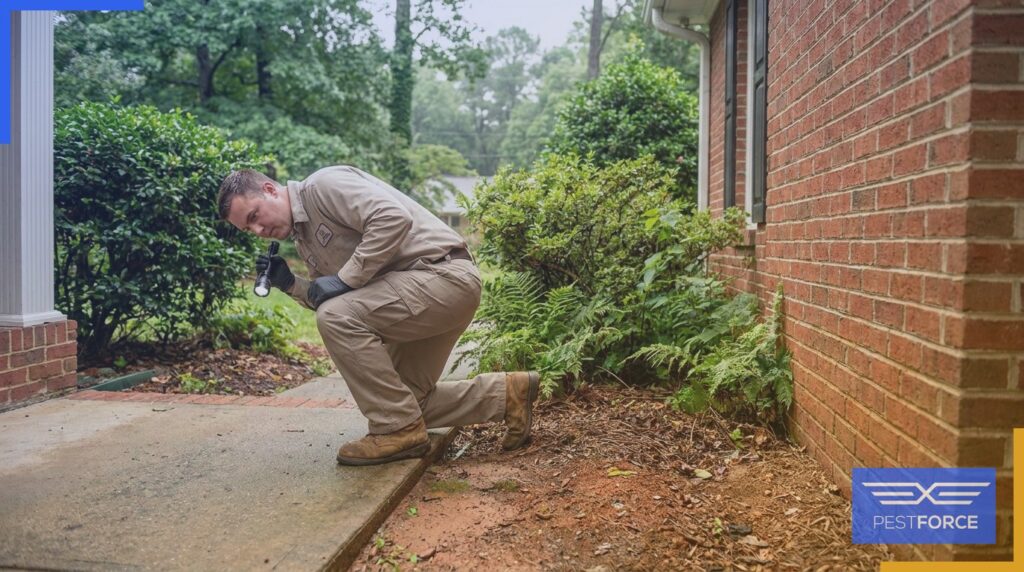
Georgia ranks among the highest-risk states in the nation for termite infestation. Georgia’s warm, humid climate and red clay soil create near-perfect conditions for subterranean termite colonies, and those colonies can consume a home’s structural wood for years before a homeowner notices any visible sign of damage. Georgia termites include several destructive species, each with distinct biology, warning signs, and treatment requirements.
Why Is Georgia One of the Worst States for Termites?
Georgia sits inside Termite Infestation Probability (TIP) Zone 1, the highest-risk classification on the USDA termite infestation probability map, designated “Very Heavy” for subterranean termite pressure alongside the Gulf South, Florida, and coastal South Carolina, according to Townhustle (2026). That map, adapted into the 2021 International Residential Code as Figure R301.2(7) by the Building America Solution Center at Pacific Northwest National Laboratory, places Georgia’s southern half and entire coastal plain in Zone 1 while the northern half rates Zone 2, Moderate to Heavy (Pestcontrolpricing.com, 2026).
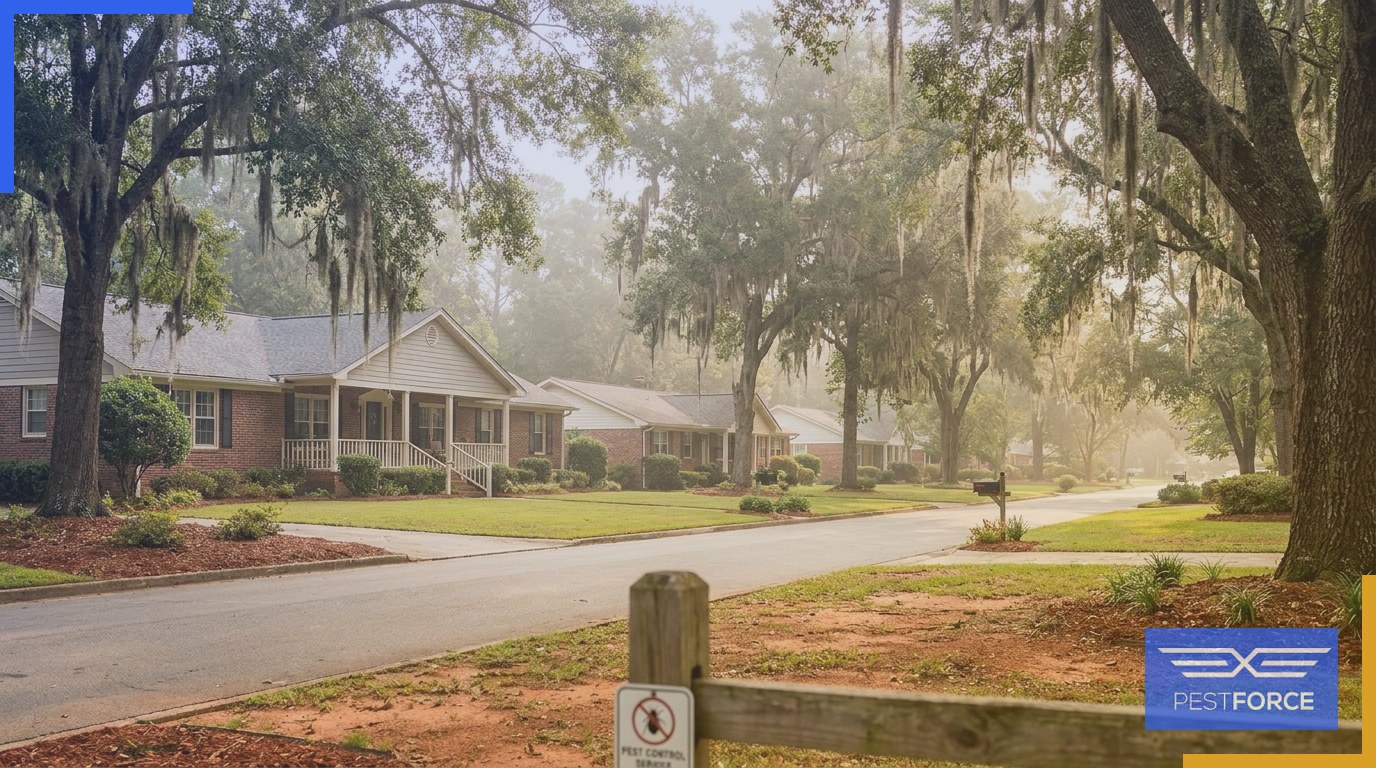
The climate does most of the damage. Georgia belongs to what entomologists call the “termite belt,” a band of border-to-border mild temperatures and above-average rainfall that subterranean termites find ideal, according to a 2025 University of Georgia CAES Field Report. Winters in northern states force colonies dormant for months, but Zone 1 ground never freezes deeply enough to kill underground colonies, so Georgia termites feed 365 days a year. A longer feeding season means more wood consumed per colony per year.
Georgia’s red clay soil makes the problem worse, and here is the misconception worth correcting. Homeowners often assume dense clay repels termites. Subterranean termites actually exploit the expansion cracks that open seasonally as clay dries and shrinks, and those cracks give workers direct access to slab foundations and crawl spaces. Clay is not a deterrent. Clay is a pathway, and the regional soil factors behind termite spread explain why established colonies track these fissures straight to the wood framing above.
Construction style completes the picture. Georgia communities run heavily toward wood-frame homes built over vented crawl spaces, a pairing that puts damp, shaded soil within inches of untreated structural lumber. Crawl spaces hold moisture, moisture softens wood, and softened wood shortens the trip from colony to dinner plate.
The risk carries a real price tag. Termite damage and control costs in Georgia exceed $125 million annually, according to Ray Noblet, entomology department head at the University of Georgia College of Agricultural and Environmental Sciences. Spread across one state’s housing stock, that figure means Georgia homeowners carry heavier annual treatment and repair exposure than homeowners in moderate-risk states, where colonies stay dormant half the year and crawl space construction is less common. The math is simple: longer feeding seasons, more active colonies, and more vulnerable structures push the per-household bill in Georgia above the national average.
What types of termites are found in Georgia?
Three types of termites infest Georgia structures: the eastern subterranean termite, the Formosan subterranean termite, and the drywood termite. The eastern subterranean termite is the dominant termite species threatening Georgia homes, and its colonies operate in every Georgia county.
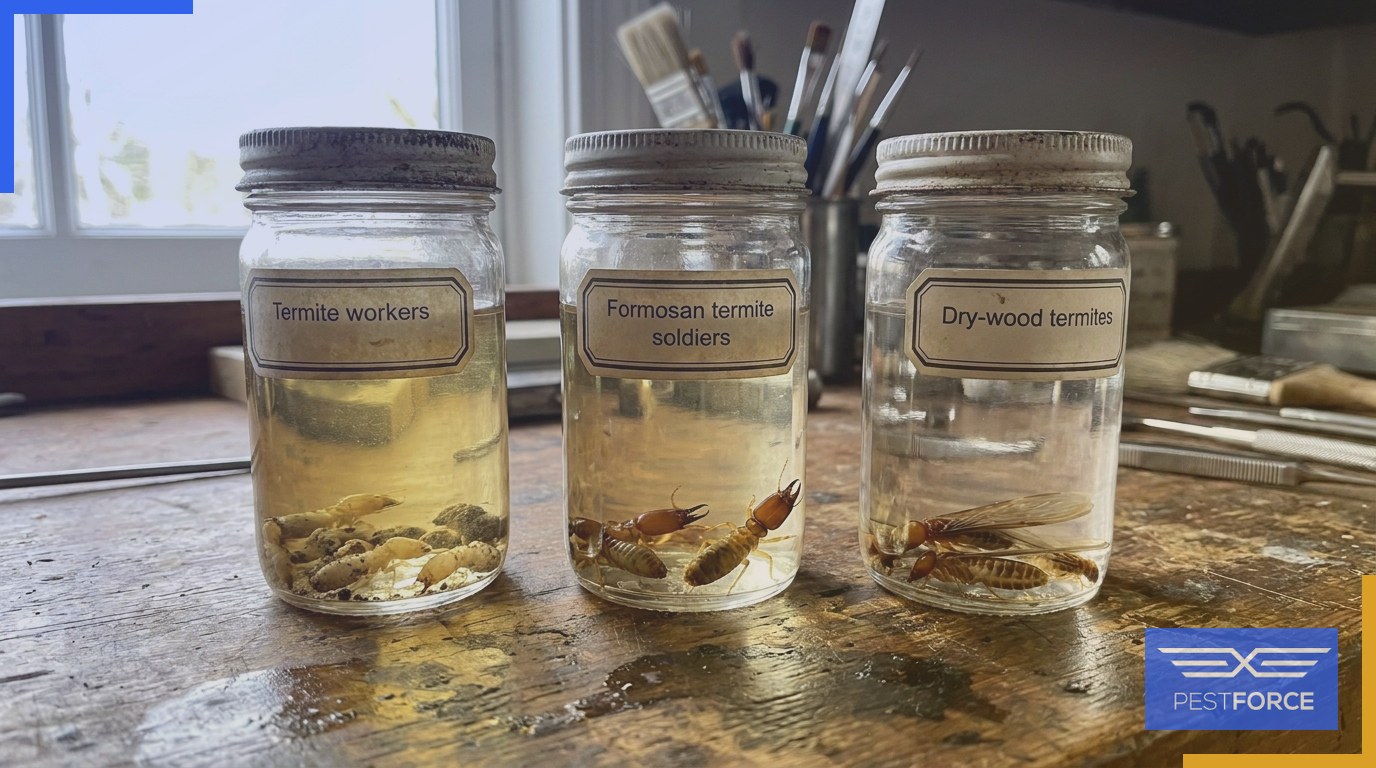
- Eastern subterranean termite (Reticulitermes flavipes). This species nests in the soil and reaches wood through mud tubes. University of Georgia Extension (2025) identifies Reticulitermes flavipes as the most widely distributed and most economically important termite in the eastern United States, and University of Nebraska-Lincoln Extension (1991) attributes 95% of termite damage to subterranean termites.
- Formosan subterranean termite. This species shows its heaviest Georgia presence along the coast and across the southern counties. The Formosan subterranean termite maintains colonies far larger than eastern subterranean colonies, and that larger workforce consumes structural wood faster.
- Drywood termite. This species is less common in Georgia and infests furniture, trim, and isolated wood members with no soil contact at all. Treatment differs from subterranean work: soil barriers and bait stations never reach a drywood colony, so control requires direct wood treatment, localized injection, or fumigation.
Every colony divides labor among three castes. Workers eat wood and feed the colony, soldiers defend it, and winged reproductives called swarmers leave to start new colonies. That division of labor is how termite colonies organize and function, and swarmers are the only caste a homeowner is likely to see.
Tell a termite swarmer from a flying ant by three features: termites carry four wings of equal length, a thick straight waist, and straight bead-like antennae, while flying ants show longer front wings, a pinched waist, and elbowed antennae.
Swarmer season in Georgia peaks in spring for eastern subterranean termites, and Formosan swarmers emerge later in the season, often at night near lights. A homeowner who writes off Formosan swarmers as a second ant swarm loses response time while the colony keeps feeding.
How do you detect a termite infestation in a Georgia home?
Detecting a termite infestation in a Georgia home starts with checking foundation walls, piers, and sill plates for mud tubes, then watching for discarded swarmer wings, hollow-sounding wood, and frass pellets. Visual checks miss hidden activity, so K9 termite detection confirms what eyes cannot reach.
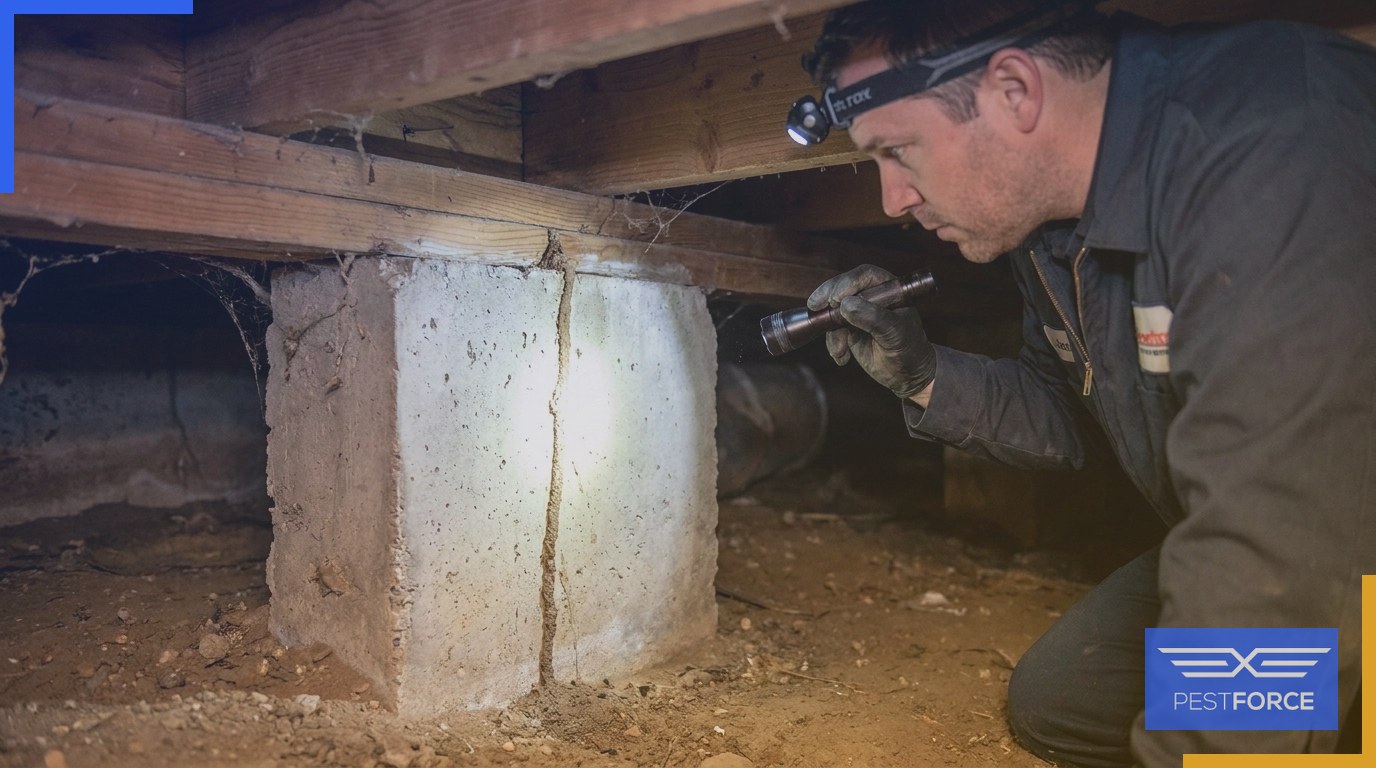
1. Inspect for mud tubes. Subterranean termite colonies use mud tubes as above-ground travel corridors that protect them from air exposure. Check foundation walls, crawl space piers, and sill plates for pencil-width earthen tunnels running from soil toward wood.
2. Check for swarmers and shed wings. Eastern subterranean termite swarmers fly most commonly February through April in Georgia, according to the University of Georgia College of Agricultural & Environmental Sciences (2025). UGA CAES reports that soon after flying, swarmers lose their wings, mate, and begin a new colony, so piles of discarded wings on windowsills deserve a close look.
3. Probe wood and listen. Tap baseboards, door frames, and exposed framing with a screwdriver handle; infested wood sounds hollow or papery. Blistered or bubbling paint over wood often signals moisture and tunneling beneath, and small frass pellets pushed out of pinholes point to drywood termite activity.
4. Know the limits of your eyes. Termites feed inside wall voids and structural framing where no surface sign appears, so a clean visual inspection does not clear a house. K9 termite detection applies to locating active termite activity inside wall voids and structural framing that visual inspection alone cannot confirm, and Pest Force uses trained detection dogs to verify activity before recommending treatment.
A word on swarmers: homeowners often treat indoor swarmers as an early warning. Seeing swarmers inside almost never means the swarm originated indoors. It typically means a mature colony, often three to five years old, is already established in or under the structure and is now reproducing. Swarmers confirm an existing infestation, and the resource on how to spot early termite damage at home covers the quieter surface clues that appear before a swarm ever happens.
What kind of damage can termites cause to Georgia homes?
Termites damage Georgia homes by consuming structural wood, including sill plates, floor joists, subflooring, and wall framing. Subterranean termites eat wood from the inside out, so infestations stay hidden until floors sag and framing loses strength. Repairs range from a few hundred dollars for isolated boards to tens of thousands for structural rebuilding.
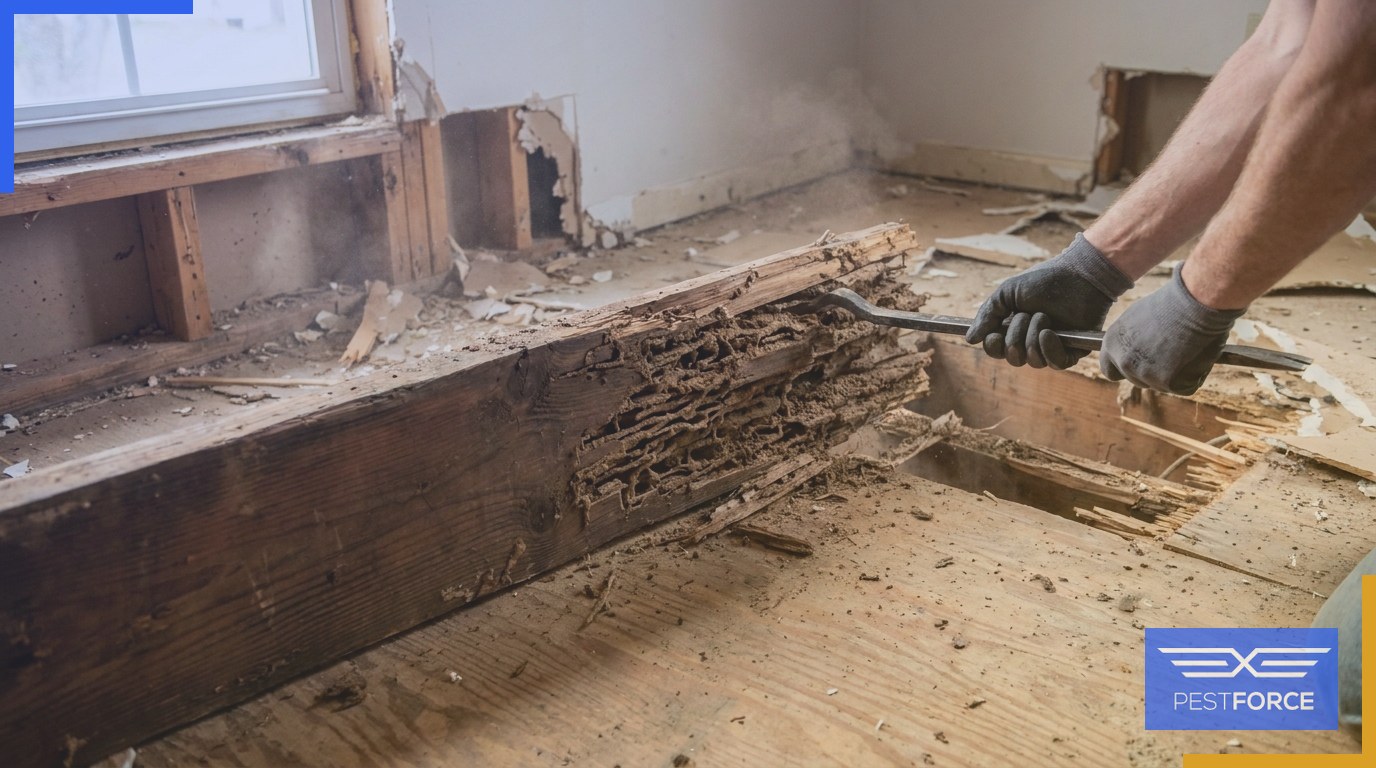
Termites cause billions of dollars in property damage across the United States each year, and standard homeowners insurance policies typically exclude termite damage entirely. Insurers classify termite damage as a preventable maintenance issue rather than a sudden, accidental loss, which is a polite way of saying the repair bill belongs to the homeowner.
The damage stays invisible because of how subterranean termites feed. Workers consume the soft interior grain of a board first and leave the outer shell and paint film intact, so a floor joist can look solid from the crawl space while the core is already hollow. By the time wood crumbles under a screwdriver or a floor starts to dip, the colony has usually been feeding for years.
Georgia’s crawl space construction carries a fundamentally different risk profile than slab foundations. Pier-and-beam homes in Monroe, Winder, and Loganville, many built before 1980, frequently have untreated wood in direct contact with soil, which satisfies both the food and moisture requirements for eastern subterranean termite colony establishment without any secondary access point. Moisture accumulation and inaccessible framing give colonies concealed feeding corridors that can go undetected for a decade.
Repair costs scale with the wood involved and the access. Sill plate replacement typically runs from several hundred dollars into the low thousands per section. Sistering or replacing floor joists costs more, often several thousand dollars, and rebuilding structural framing inside a tight crawl space can reach five figures.
What are the treatment options for termites in Georgia?
Georgia homeowners have three professional termite treatment options: liquid Termidor barrier treatments, termite bait station systems, and combined programs. Termidor barriers protect the structure’s perimeter, bait stations eliminate colonies at the source, and combined programs deliver both layers of defense.
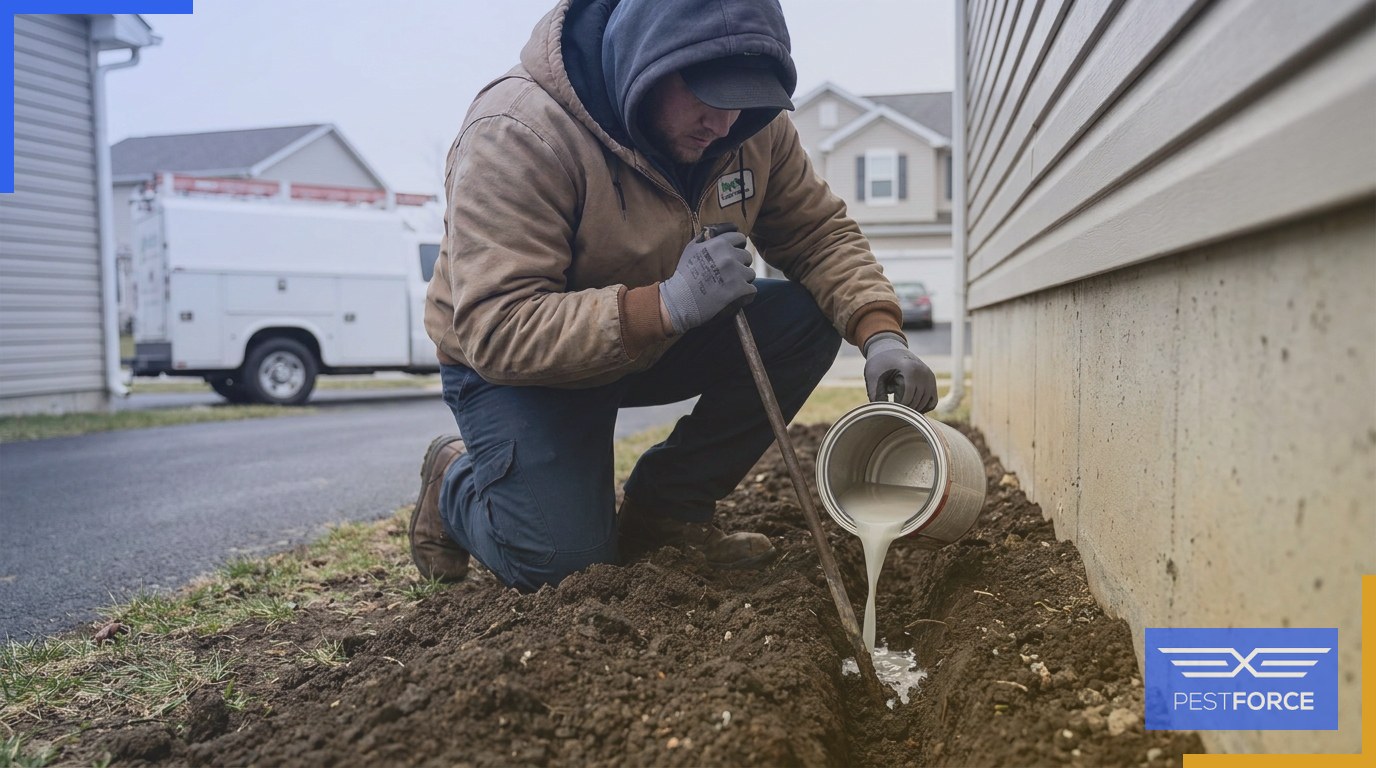
- Termidor liquid barrier treatment. Termidor liquid barrier treatment contains fipronil, which termites cannot detect and spread colony-wide through contact transfer. Technicians trench the soil around the foundation and treat the fill to create a continuous zone, and foraging workers carry fipronil back to nestmates that never touched the treated soil. Pest Force provides Termidor liquid treatment as its primary perimeter defense, and the Pest Force termite and pest authority covers how the program is installed and maintained. The subterranean species control overview explains why the transfer effect suits Georgia’s eastern subterranean termites.
- Termite bait station systems. Termite bait stations follow a monitor-then-bait protocol that eliminates the colony at the source rather than only blocking foragers. Stations sit in the soil around the home, and when monitors show activity, the licensed Georgia termite specialists at Pest Force swap in active bait that workers carry back to the queen.
- Combined programs. Liquid and bait treatments are often sold as alternatives, but the two methods work best together. The Termidor barrier provides immediate perimeter protection while bait stations monitor for and collapse satellite colonies that fall outside the treated zone.
- Annual inspection warranties. Professional termite treatments typically carry a one-year warranty, renewable at each annual inspection. The warranty covers a yearly re-inspection of the structure and re-treatment at no added cost if termites return during the coverage period.
- DIY treatment. Store-bought sprays and stakes rarely hold up in Georgia. Subterranean colonies nest deep below the slab, red clay soil makes a continuous barrier hard to build without commercial equipment, and retail products lack the concentration and transfer chemistry that make fipronil effective. Miss a section of the perimeter and the colony keeps feeding.
How can Georgia homeowners prevent termite infestations?
Georgia homeowners prevent termite infestations by eliminating soil-to-wood contact at the foundation, controlling crawl space and perimeter moisture, keeping wood and mulch away from the home, and scheduling annual professional inspections, since Georgia sits in high-pressure termite Zone 1.
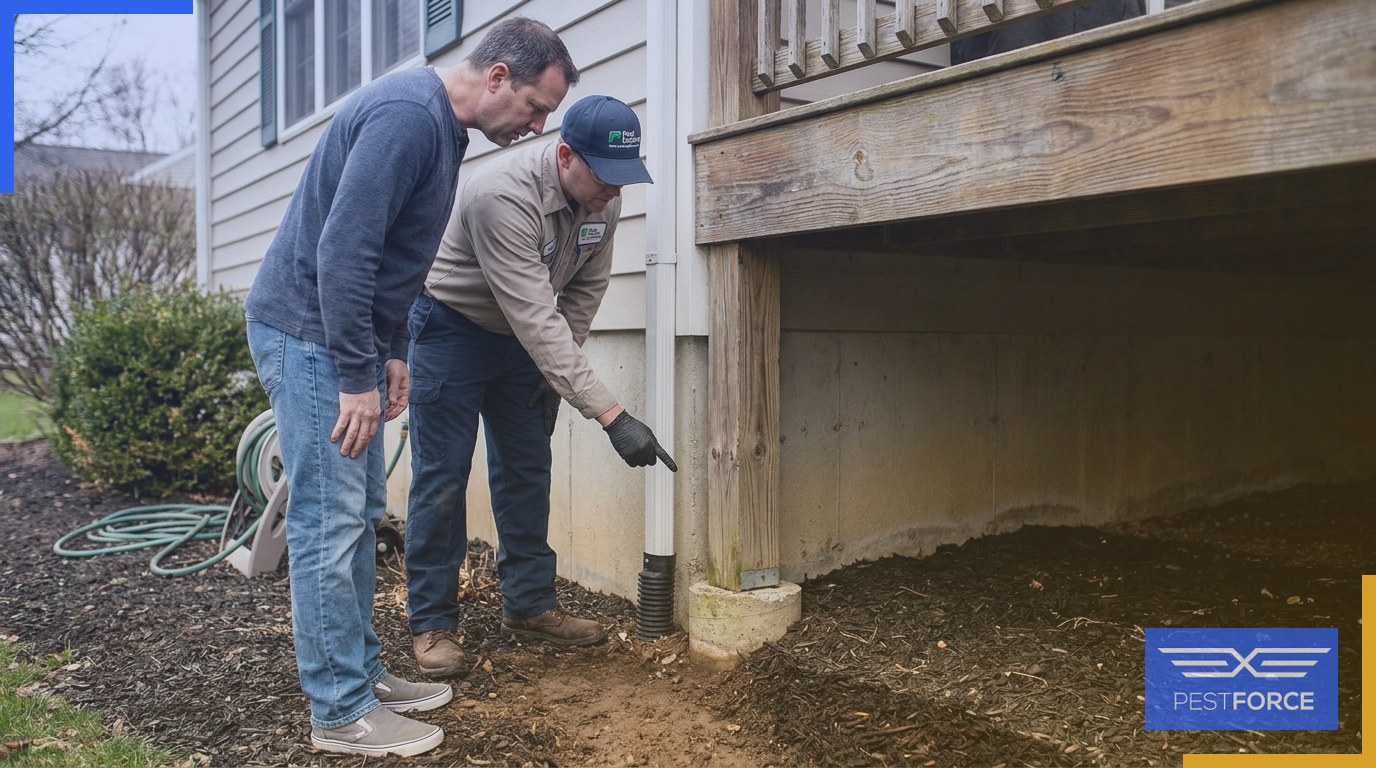
1. Break soil-to-wood contact. Termites enter a house where wood touches soil. Keep siding, exterior trim, and door frames off the ground with a visible gap of bare foundation, and set deck posts and porch framing on concrete piers rather than buried lumber.
2. Control moisture around and under the home. Moisture draws termites. Grade the yard so water runs away from the foundation, keep gutters and downspouts draining clear of the walls, and consider crawl space encapsulation, which dries out the damp conditions Georgia’s humidity creates under a house.
3. Move wood, debris, and mulch off the perimeter. Store firewood away from the house, pull out old stumps and buried scrap lumber, and keep mulch beds back from foundation walls. Pine-straw and conifer-based beds, common in Georgia landscaping, are a particularly high-risk termite attractant when piled against the foundation; cedar mulch is meaningfully less attractive to termites and is the better specification for foundation beds.
4. Schedule an annual professional inspection. In Zone 1 Georgia, a yearly inspection is the foundation of any prevention program, because colonies feed hidden and homeowners rarely catch early activity. Pest Force, a family-owned Georgia company, includes annual inspections in the year-round termite defense for Georgia homes and backs the service with a 100% Happy or You Don’t Pay guarantee.