
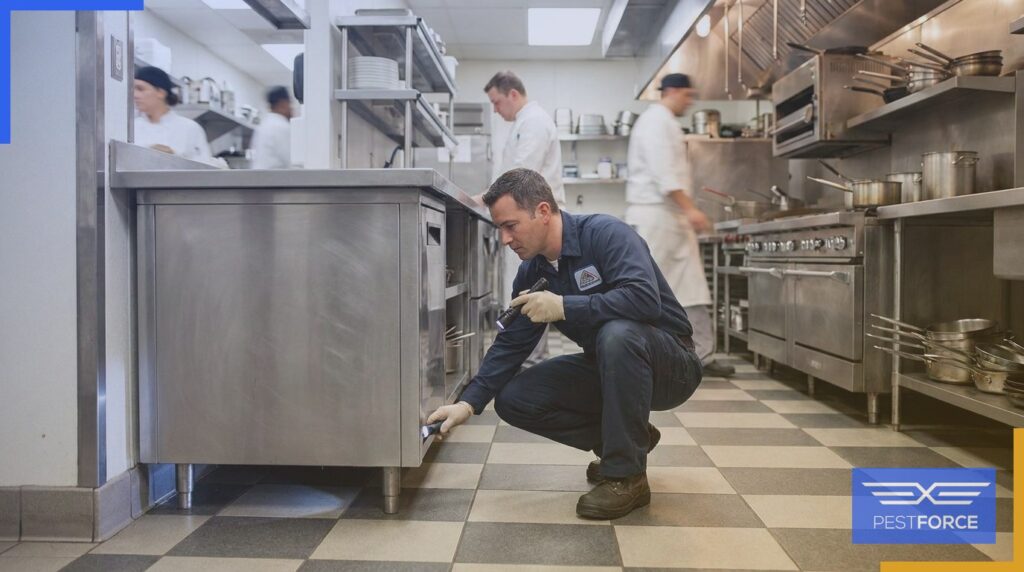
Restaurant pest control in Georgia carries stakes no other commercial sector faces: a single cockroach sighting during a health inspection can suspend a food service license, and one rodent photo posted online can permanently damage a restaurant’s reputation. Georgia restaurants need pest control programs built around Georgia Department of Agriculture and county health code requirements, using integrated pest management methods safe for food-handling environments. Pest Force delivers restaurant-specific pest control with compliance documentation and service scheduling that never disrupts kitchen operations.
Why are restaurants and food service facilities at higher pest control risk than other Georgia businesses?
Restaurants and food service facilities face higher pest control risk than other Georgia businesses because commercial kitchens concentrate food, moisture, grease, and warmth in one footprint, and because Georgia health departments classify pest activity as a critical public health violation carrying closure authority.
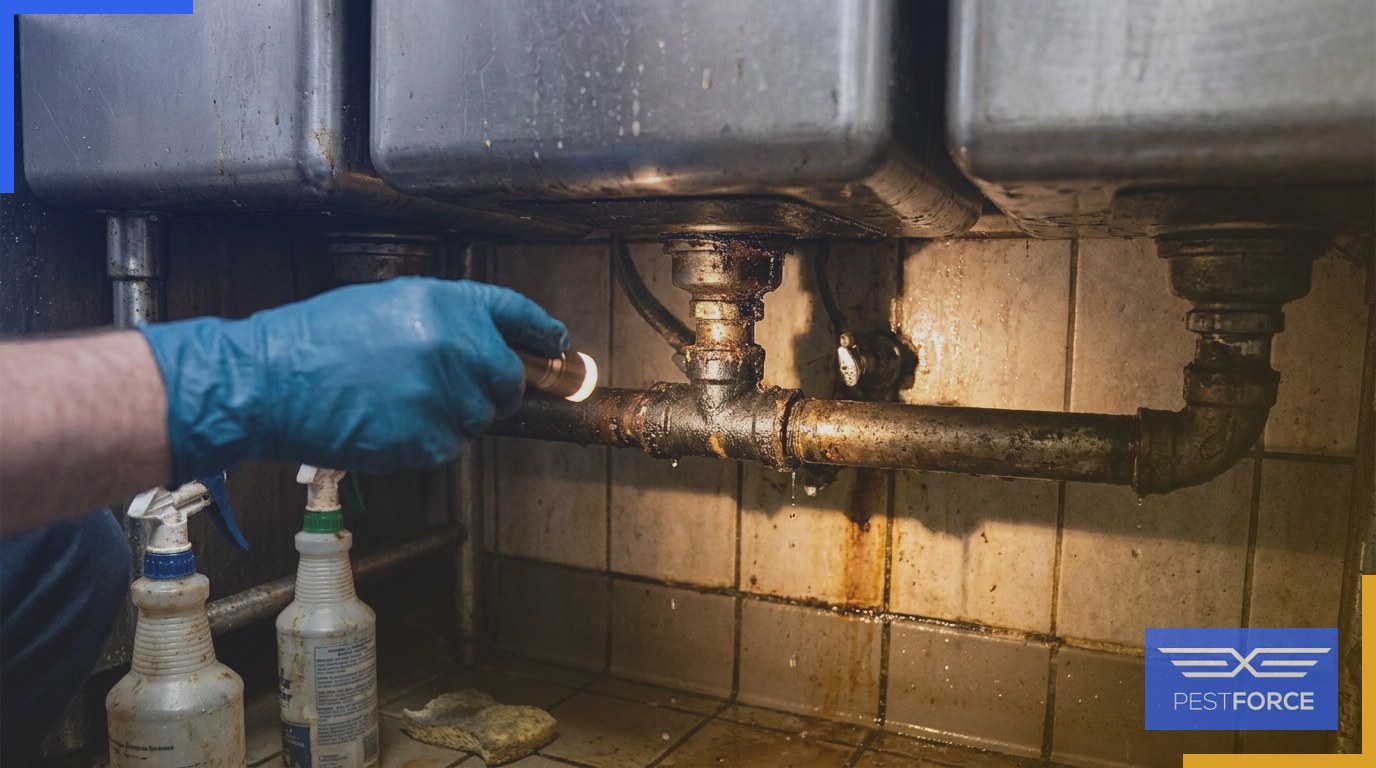
A commercial kitchen gives pests everything they need around the clock. Food, moisture, grease, and warmth build up nightly around fryers, floor drains, walk-in coolers, and dish pits, creating harborage conditions that offices, retail stores, and warehouses never produce. Cockroaches, rodents, and flies find steady calories and standing water even in well-run kitchens.
High staff turnover and daily delivery traffic widen the problem. Rotating closing crews clean unevenly, leaving grease film and food debris under equipment, and incoming shipments can carry German cockroaches or rodents straight through the back door. These recurring sanitation gaps sustain infestations even after a professional treatment knocks the active population down.
The regulatory stakes separate food service from every other commercial account. Pest activity in a Georgia restaurant causes health code violations that can result in license suspension or closure. Georgia scores restaurant inspections on a 100-point scale, and a score below 70 is rated Unsatisfactory, according to Southwest Georgia Public Health District 2024 guidance. Georgia Food Safety’s 2025 inspection guidance notes that inspectors can order immediate suspension of operations for imminent health hazards and set a 3-day correction window for priority violations requiring re-inspection. Fieldwork’s 2025 analysis adds that a single pest sighting during an inspection carries the potential for immediate closure. County health departments treat a live pest sighting as an automatic critical violation rather than a minor infraction, which puts same-day closure on the table during any unannounced visit.
County scoring adds a layer most owners miss. In Fulton, Gwinnett, and DeKalb counties, inspectors score pest evidence on a sliding scale: a live cockroach sighting is an automatic critical violation, while documented evidence of prior professional treatment with no active pest activity can be scored as a non-critical observation. Documented, ongoing pest control service therefore directly affects inspection scoring, not just pest absence. The health code rules for food service pest control define how inspectors classify that evidence, and service records supply the documentation they request.
The reputational exposure is just as specific to food service. Georgia Food Safety’s 2025 guidance notes that restaurants should expect at least one unannounced inspection every six months, with results posted publicly online and displayed near the entrance. One customer photo of a roach on social media, or one public inspection record showing a critical violation, reaches more potential diners than any correction notice ever will. Owners recovering from a failed inspection must correct every cited violation, pass a re-inspection, and keep operating under a public record that outlives the fix. No office park or warehouse carries that kind of customer-facing risk.
What pest control approach does Pest Force use in commercial kitchens and food service environments?
Pest Force uses integrated pest management, a documented program that combines exclusion, monitoring, sanitation guidance, and targeted treatments inside commercial kitchens and food service environments. This program replaces calendar-based chemical spraying with a system built around food safety compliance.
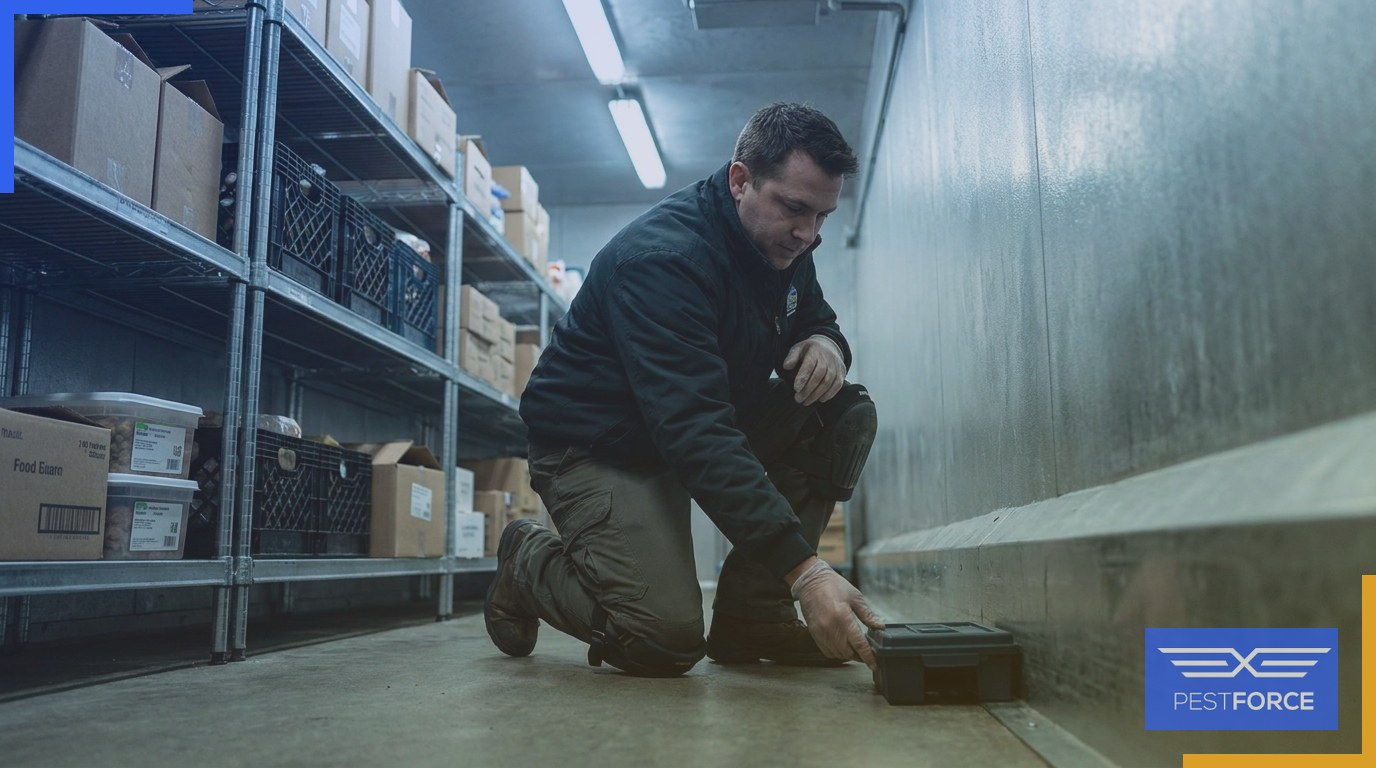
Integrated pest management is preferred over chemical-only spray programs in food service environments because it minimizes pesticide contact with food-contact surfaces. The U.S. Department of Agriculture cites 7 U.S.C. § 136r, which defines the approach as a sustainable combination of biological, cultural, physical, and chemical tools that minimizes economic, health, and environmental risks. FDA Food Code Section 6-501.111 requires food service establishments to take effective measures to exclude pests, and the National Pest Control Authority identifies IPM as the preferred operational model for meeting that mandate. Spray residue near a prep table is what an inspector finds first.
Inside food-handling areas, Pest Force technicians replace broad liquid sprays with gel baits, crack-and-crevice applications, mechanical traps, and exclusion work. The National Pest Control Authority divides food facilities into treatment zones: Zone 1 covers active food preparation surfaces and open food storage, prohibits most residual pesticides during operation, and requires products carrying food-handling label language, while Zone 3 covers the external perimeter and utility areas and allows a broader range of formulations. Baits and traps deliver control inside Zone 1 without breaking those limits.
Monitoring stations and glue boards supply ongoing pest activity data between service visits. Technicians read catch trends at every visit, and those readings decide where the next treatment goes. A glue board under a prep line often reveals activity weeks before kitchen staff spot it.
Each visit ends with written sanitation and structural recommendations delivered to the kitchen manager. These recommendations serve as kitchen pest prevention strategies that staff can apply between visits, covering items like door sweep gaps, drain sanitation, and dry storage rotation.
Those same records matter during inspections. IPM documentation shows an inspector that the operator is taking proactive, good-faith steps, with service logs, monitoring data, and corrective actions on file. According to iFactory in 2026, food safety audit standards treat integrated pest management for food service as a mandatory prerequisite built on documented monitoring, structural exclusion, and corrective action chains.
How does Pest Force structure its restaurant pest control service visits?
Pest Force structures every restaurant visit around a fixed sequence: service occurs during non-operating hours or between meal services, the technician inspects and treats documented pest activity, and the visit closes with a written service report filed on-site.
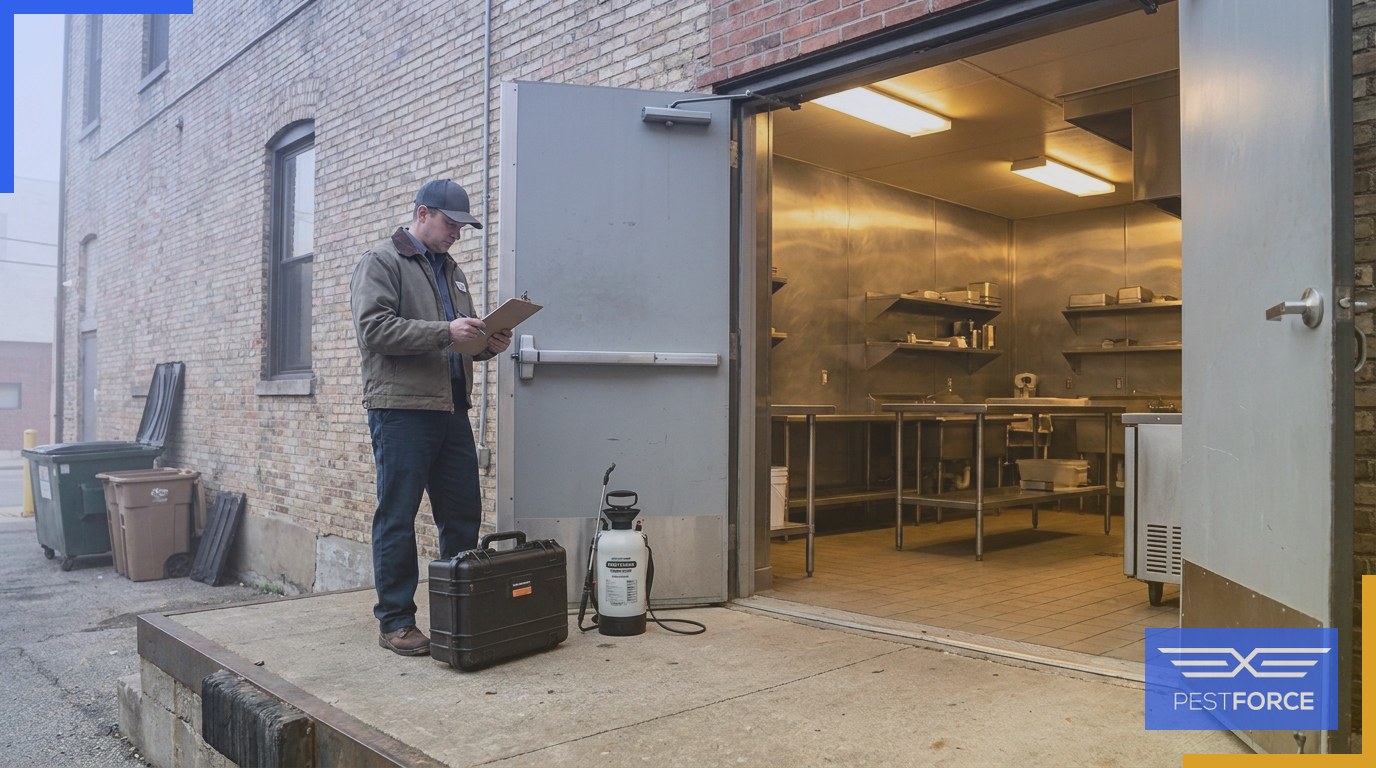
1. Scheduling around food service. Restaurant pest control service must be scheduled during non-operating hours or between meal services to avoid pesticide contact with open food and food-contact surfaces. Pest Force books visits before opening, after close, or in the lull between lunch and dinner service.
2. Written service report. Each visit produces a written service report recording pest activity findings, treatment locations, products used, and technician sign-off. Nothing gets treated without a paper trail.
3. Compliance documentation. The Pest Force restaurant program includes written service reports and pest activity logs that serve as compliance documentation during health inspections. According to the National Pest Control Authority, FDA Food Code Section 8-304.11 gives inspectors authority to review records relevant to compliance, and most state health codes require pest control records available on-site. A generic commercial pest control contract does not satisfy food service compliance requirements: a standard quarterly spray program produces no pest activity logs, treatment location records, or chemical use records for an inspector to review.
4. Visit frequency. Pest Force matches visit frequency to establishment type and infestation pressure, with weekly, bi-weekly, and monthly cadences available. The restaurant pest service pricing breakdown details how cadence affects program cost.
5. Emergency and follow-up visits. Emergency or follow-up visits are available between scheduled service for active infestation events. After a failed pest inspection, Georgia restaurants typically have 10 days or fewer to resolve violations before a re-inspection, and Pest Force’s emergency scheduling is designed to meet that window. The restaurant pest service scheduling covers how urgent and after-hours appointments are booked.
Which pests most commonly threaten Georgia restaurants and commercial kitchens?
German cockroaches, rodents, drain flies, fruit flies, and Pharaoh ants most commonly threaten Georgia restaurants and commercial kitchens. Cockroaches and rodents are the leading pest genera cited in Georgia food service health inspection failures, while flies and ants follow sanitation lapses and treatment errors.
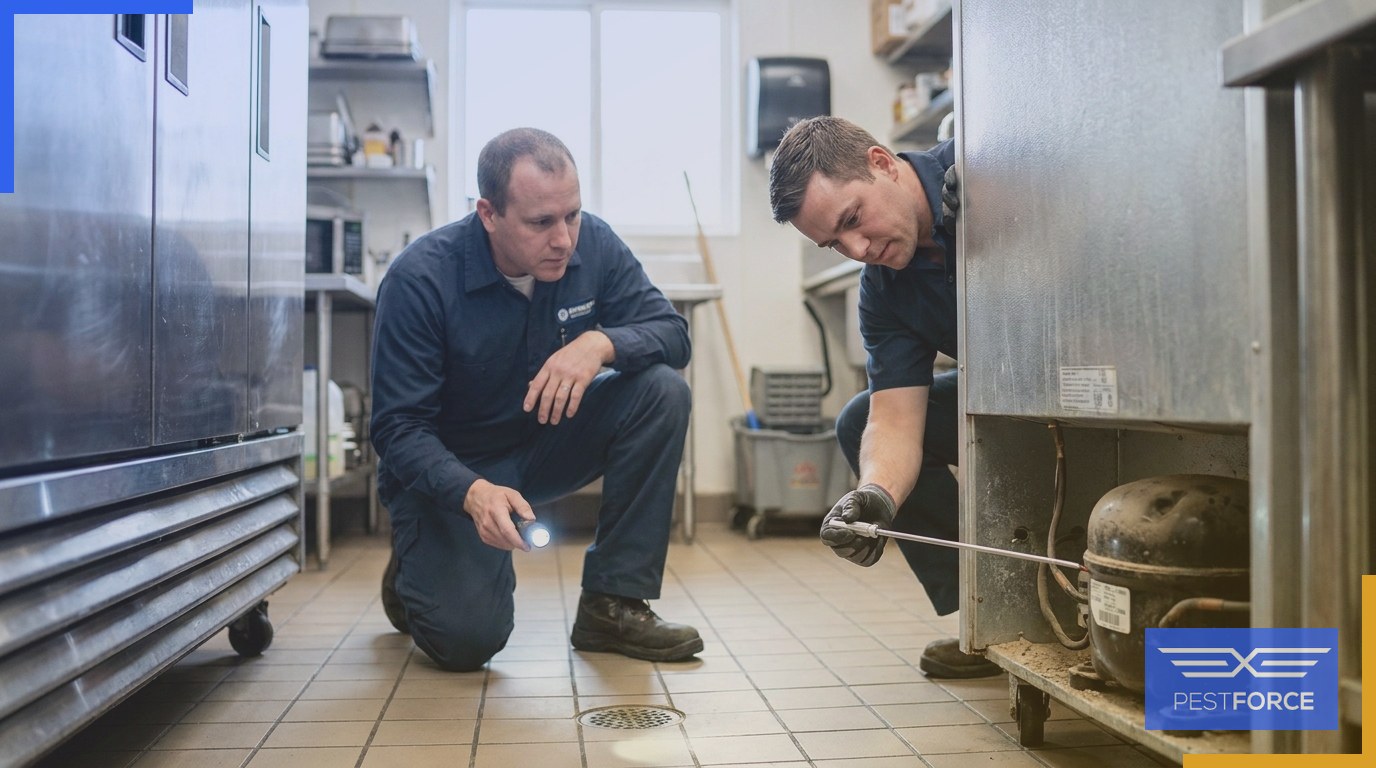
German cockroaches are the dominant kitchen pest. Fieldwork (2025) ranks German cockroaches as the number one pest problem in U.S. restaurants. German cockroaches harbor in the compressor motor cavities of refrigeration units, in the void beneath three-compartment sinks, and around grease trap surrounds, and the kitchen pests unique to Georgia food service concentrate in exactly these warm, wet, grease-fed voids. A standard exterior perimeter program never reaches these interior zones, which is why restaurant-naive pest control companies routinely fail to resolve cockroach infestations even after multiple treatments.
Rodents enter kitchens through gaps around utility penetrations and worn loading dock seals. Once inside, rodents contaminate stored dry goods with droppings and urine, and rodent evidence triggers an immediate critical violation during a health inspection.
Drain flies and fruit flies breed in floor drain biofilm and overripe produce. Drain flies and fruit flies are sanitation-linked pests, so control requires drain treatment and produce rotation rather than routine spraying. Fogging a kitchen does nothing to the biofilm lining the floor drains.
Pharaoh ants are a food-service-specific ant species that scatters under chemical pressure, which makes improper treatment counterproductive. Pharaoh ant colonies fracture and relocate when exposed to repellent sprays, turning a single original colony into a multi-site infestation. Bait-only IPM protocols are mandatory for ant control in food service settings, and repellent contact sprays have no place in a commercial kitchen.
Which Georgia food service businesses does Pest Force serve?
Pest Force serves restaurants, commercial kitchens, cafeterias, food trucks, and catering facilities across Georgia. The client base spans full-service restaurants, fast casual and quick-service concepts, and bar and nightclub venues, along with institutional cafeterias in schools, hospitals, and corporate campuses.
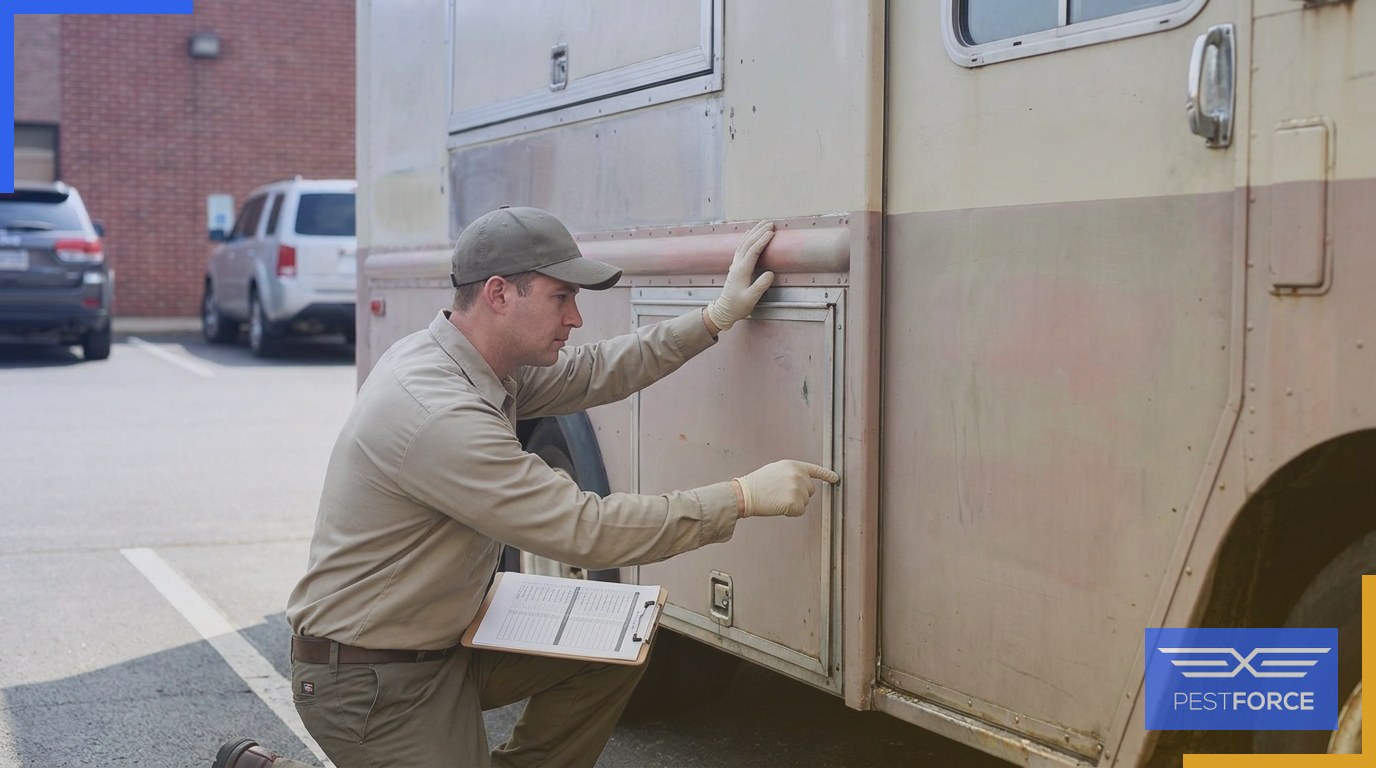
Pest Force also services food trucks, catering kitchens, and commissary facilities. A food truck has no permanent structure to seal, so exclusion work is off the table; programs for mobile and pop-up kitchens rely on sanitation protocols, monitoring, and baiting, and service frequency typically runs higher than for fixed locations.
Pest Force covers [specific Georgia service areas to be confirmed]. The commercial pest control parent page maps the full Georgia coverage, and the industry-specific commercial pest plans detail program structures by facility type. Corporate campuses that run both cafeterias and administrative buildings often pair kitchen service with structured pest management for offices under a single agreement.
Sources
- Southwest Georgia Public Health District, “Southwest Health District Provides Insight into Restaurant Inspections in Georgia” (2024)
- Georgia Food Safety, “Georgia Food Service Inspections & Compliance Guide” (2025)
- Fieldwork, “Why Pest Control Is Important for Restaurants and Food Safety” (2025)
- National Pest Control Authority, “Pest Control Services for Food Service Establishments: Regulatory Requirements”
- iFactory, “Food Plant Pest Management (IPM) Inspection Checklist” (2026)
- U.S. Department of Agriculture, “Integrated Pest Management”