
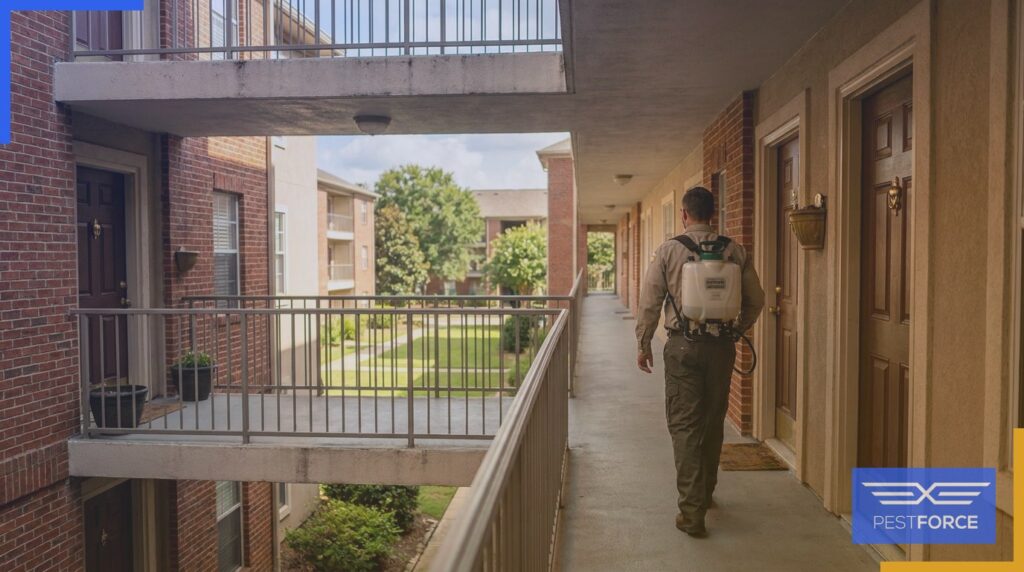
Multi-family pest control protects Georgia apartment complexes, townhome communities, and HOA-governed neighborhoods from infestations that single-unit treatments cannot contain. One infested apartment pushes pests into adjacent units within days, and an untreated common area creates liability across the entire community. Pest Force runs recurring multi-unit pest control programs for Georgia landlords, HOAs, and property management companies, with scheduling, documentation, and compliance support built into every service plan.
What pest control challenges are unique to multi-unit properties and apartment complexes?
The defining challenge of a multi-unit residential property is structural pest migration. Cockroaches, rodents, and bed bugs travel from unit to unit through the building itself, and a single untreated unit reinfests every treated neighbor regardless of how thorough the individual service was.
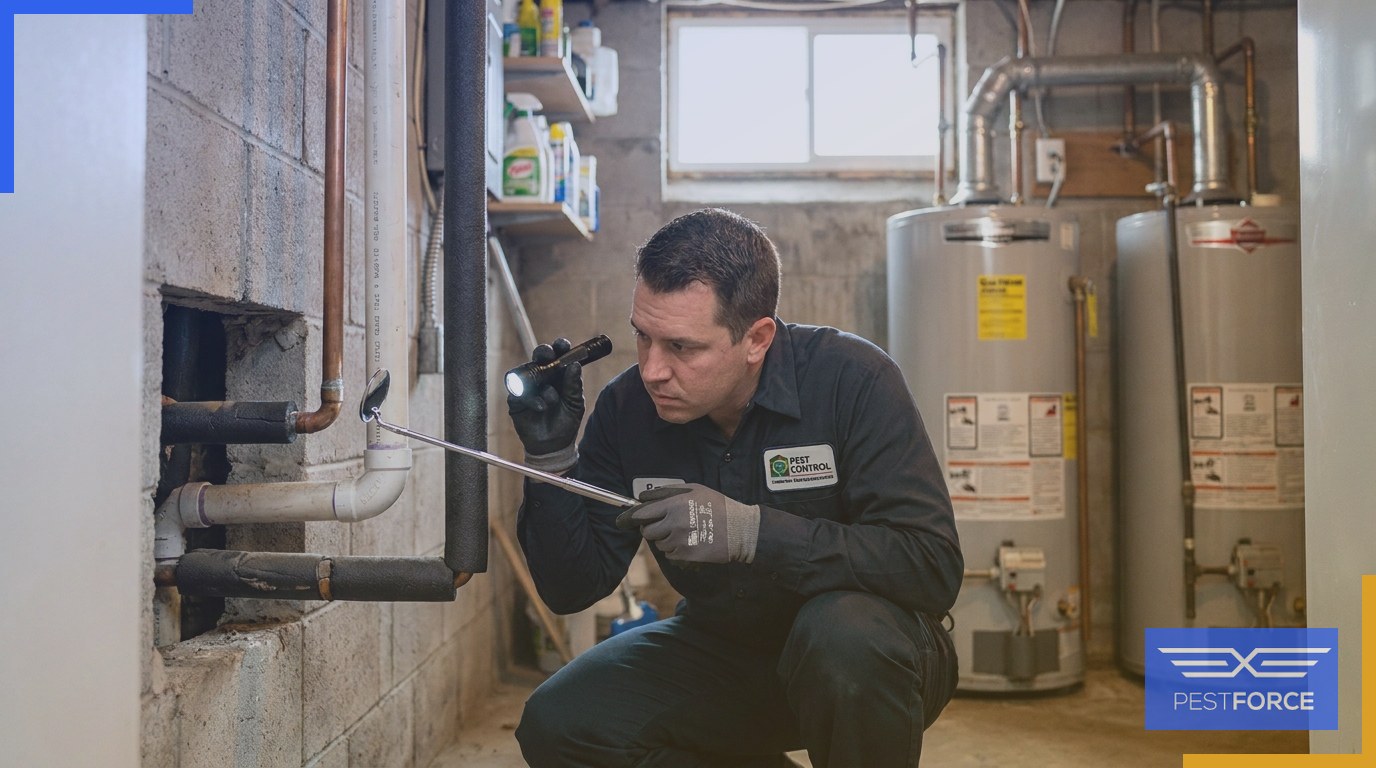
Pest infestation in multi-unit buildings traces back to shared walls, plumbing chases, and common areas that let pests migrate freely between units. Utility corridors and pipe chases run vertically through the structure, so a roach population established in one kitchen reaches the units above and below without crossing a single hallway.
Common areas function as harborage zones that seed adjacent units continuously. Laundry rooms, trash compactors, mailrooms, and pool decks supply food, moisture, and shelter within steps of every front door, and a rodent population in the compactor room turns into a building-wide rodent problem.
Tenant turnover adds a pressure that owner-occupied homes never face. Bed bug introductions arrive with used furniture and luggage, German cockroaches hitchhike in moving boxes, and each move-in can seed a building that was previously clear. Every lease resets the clock.
Georgia’s climate removes the seasonal relief that colder states get. German cockroaches, American cockroaches, subterranean termites, and rodents stay active through every month of a Georgia year, and those endemic pests exploit the construction gaps that multi-unit buildings always carry. New construction apartment complexes in Georgia often discover pest pressure within the first year of occupancy, because construction debris, incomplete perimeter seals, and landscaping installation attract rodents and cockroaches before tenant populations stabilize.
Treating units one at a time ignores the pathway the pests actually travel, so a community-wide or building-wide program is the only structurally sound solution for a multi-unit property. Pest Force multi-unit programs are designed for apartment complexes, townhome communities, and HOA-governed properties in Georgia, and the pest control for commercial properties extends the same recurring program structure across the rest of a management company’s portfolio.
What are Georgia landlords’ and property managers’ legal responsibilities for pest control?
Georgia landlords carry a legal obligation to maintain habitable conditions, and Georgia courts have interpreted that duty to include pest-free living spaces. The Safe at Home Act (HB 404), effective July 1, 2024, made that duty express by adding a warranty of habitability to O.C.G.A. § 44-7-13(b), requiring rental premises fit for human habitation, according to the Georgia Appleseed Center for Law & Justice (2024).

- Infestations the landlord must fix. Landlords must resolve pest problems the tenant did not cause, including rats, roaches, mice, bed bugs, and ants, according to iPropertyManagement.com. Georgia imposes no state requirement for routine pest testing, so responsibility attaches when an infestation appears.
- The statute never says “pest-free.” Georgia’s habitability statute does not explicitly list pest-free as a required condition. Courts and rental arbitration panels have consistently filled that gap, treating significant infestations, especially roaches, bed bugs, and rodents, as habitability violations. A landlord who lacks documented treatment records therefore faces disproportionate liability in any dispute.
- Documentation is the primary legal defense. Property managers use pest control service records to defend against tenant habitability complaints and document compliance with Georgia law. Without written records, a landlord enters a dispute with no evidence of treatment.
- Lease clauses only go so far. Clauses assigning pest control to tenants are only partially enforceable in Georgia. Infestations caused by structural defects or unsanitary common areas remain the landlord’s obligation regardless of lease language, according to Always Innovative Management Services.
- Response window. Property managers responding to tenant pest complaints have a narrow window to act. Georgia rental law specifies no fixed number of days, but courts have found unreasonable delay to constitute constructive breach of habitability.
Landlord Responsibilities for Pest Control in Georgia explains Georgia landlord legal pest duties in depth, and How to Write a Pest Control Clause in a Georgia Rental Lease covers drafting a rental pest control clause that Georgia courts will enforce.
How does Pest Force’s multi-unit pest control program work for apartment complexes?
Pest Force bulk scheduling contains coordinated unit-access windows, common-area treatments, and written service records suitable for tenant documentation. Pest Force services multiple units and shared spaces in a single recurring visit, with the treatment cycle matched to property size and pest pressure.
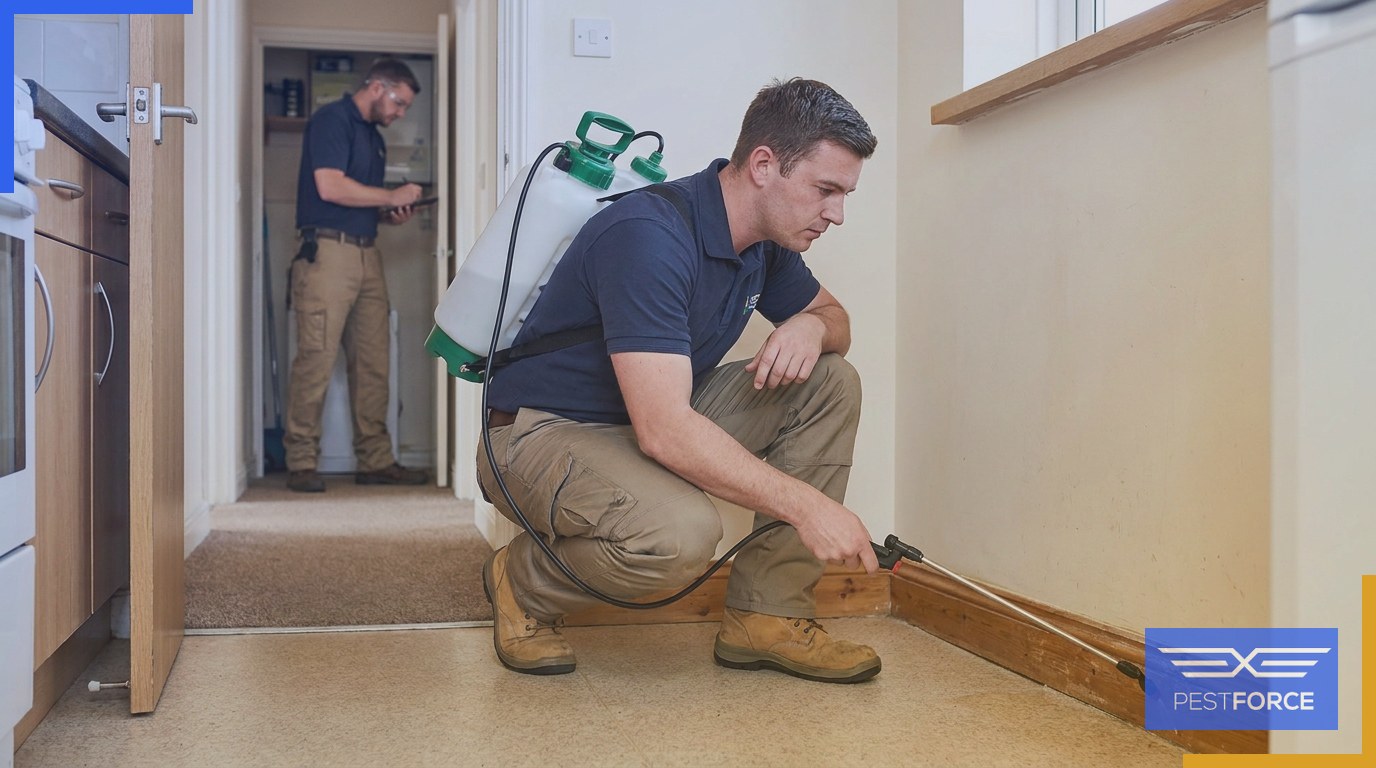
Pest Force inspects the property, maps unit counts and common areas, and sets the multi-family property treatment cadence: monthly, bi-monthly, or quarterly service depending on property size and pest pressure.
Pest Force schedules coordinated service windows that treat multiple units and common areas in one visit, which minimizes tenant disruption and cuts the access coordination burden on property managers.
Laundry rooms, trash rooms, breezeways, and exterior perimeters receive treatment as part of every program, not billed as add-ons.
Pest Force technicians leave written service records after every visit, and Pest Force provides landlords and property managers with branded or neutrally formatted service completion reports suitable for tenant-facing communication and code enforcement documentation.
The reactive alternative almost always costs more than a proactive bulk program because roaches and rodents do not respect lease boundaries: a single untreated unit functions as a reservoir that reinfects treated neighbors, causing repeated callbacks that exceed the cost of a scheduled community-wide service.
Property managers can find the full logistics detail, from access coordination to visit scheduling, in bulk pest control for apartment complexes.
How does Pest Force serve HOA communities and their common area pest control needs?
Pest Force serves Georgia HOA communities through recurring pest control programs that treat clubhouses, pool decks, landscaping, parking structures, and other shared amenities on a defined schedule, while individual unit interiors remain the pest control responsibility of owners and tenants.
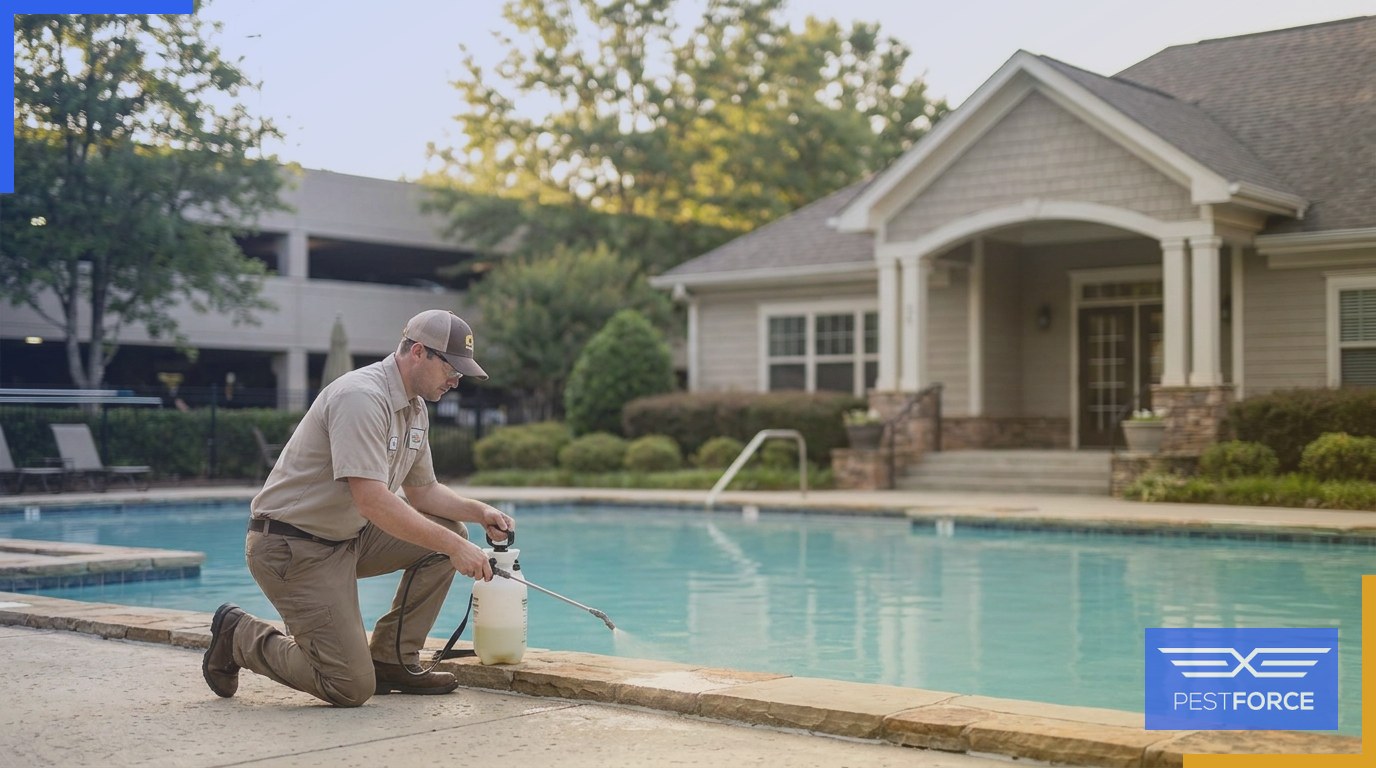
HOA boards carry pest control responsibility for shared amenities, landscaping, and community structures, not individual unit interiors. Most Georgia CC&Rs stop HOA responsibility at the unit threshold, and a service agreement that mirrors the community’s CC&Rs in writing prevents the most common source of HOA pest liability disputes.
Subterranean termites show why the boundary matters. Colonies move through connected wooden fences, pergolas, and shared decking, and termites do not read CC&Rs; one untreated pergola in a shared structural element can become a neighborhood-wide repair bill at the board’s expense.
Pest Force builds HOA pest programs for common areas around a set schedule, with seasonal adjustments for Georgia pest pressure. Written reports after each visit give boards documentation for liability protection and give residents transparency about what was treated, where, and when.
Pest Force outlines scheduling, scope, and reporting details for Georgia boards in HOA Pest Control Programs: Protecting Community Common Areas.
How should property managers handle bed bug infestations in apartment buildings?
Property managers should treat every bed bug complaint as a building-wide event: isolate the reported unit, inspect adjacent units immediately, deploy K9 detection to map the infestation, and follow a documented treatment protocol. Fast containment keeps a one-unit problem from becoming a whole-building problem.
1. Isolate the reported unit and inspect its neighbors. Bed bugs spread through shared walls, furniture moved during tenant turnover, and hallway traffic, so a single complaint requires assessing adjacent units immediately. Pest Control Technology, reporting on a CDC and EPA joint statement, confirms that bed bugs travel between units through wall voids or by direct human transport. Bed bugs do not respect lease lines.
2. Deploy K9 detection before committing to a treatment plan. Canine sweeps are the fastest and most accurate way to determine the true extent of an infestation across multiple units. Bed bug spread across apartment units precedes K9 detection deployment, which identifies active infestations before the bed bugs reach adjacent units. The K9 inspection teams for multi-unit properties identify active infestations that visual inspection misses, and Pest Force’s K9 detection service, covered under Commercial K9 Detection Services, surveys entire floors or buildings.
3. Tie every complaint to a written protocol. Property managers should link tenant complaint response to a documented inspection and treatment protocol: How to Handle a Pest Complaint from a Tenant covers intake and documentation, while Preventing Bed Bug Spread Across Apartment Units and the multi-unit bed bug containment strategies cover unit-to-unit control. Documentation also protects the owner legally. According to tenant-rights.com, Georgia law treats bed bugs under general habitability standards, so landlords usually carry responsibility for extermination unless a tenant’s actions clearly caused the infestation.
4. Schedule follow-up visits. Pest Control Technology reports that bed bug control in multi-family housing usually requires multiple visits by a licensed pest control operator, so managers should budget and communicate accordingly.