

Organic and botanical pest control methods rely on plant-derived or naturally sourced substances rather than synthetic pesticides. Georgia homeowners and businesses use organic pest control products as a lower-toxicity option against ants, roaches, fleas, and mosquitoes. Neem oil, pyrethrin, diatomaceous earth, essential oils, and boric acid differ in mode of action, target pest list, and real-world limitations. Those limits decide whether a product actually works, so matching the product to the pest matters more than the label.
What are organic and botanical pest control methods, and how do they differ from conventional pesticides?
Organic and botanical pest control methods use active ingredients derived from plants, minerals, or microbes rather than synthetically manufactured compounds. Conventional pesticides are laboratory-synthesized chemicals such as pyrethroids and neonicotinoids. Both classes kill, repel, or disrupt pests, and both are legally pesticides under federal law.
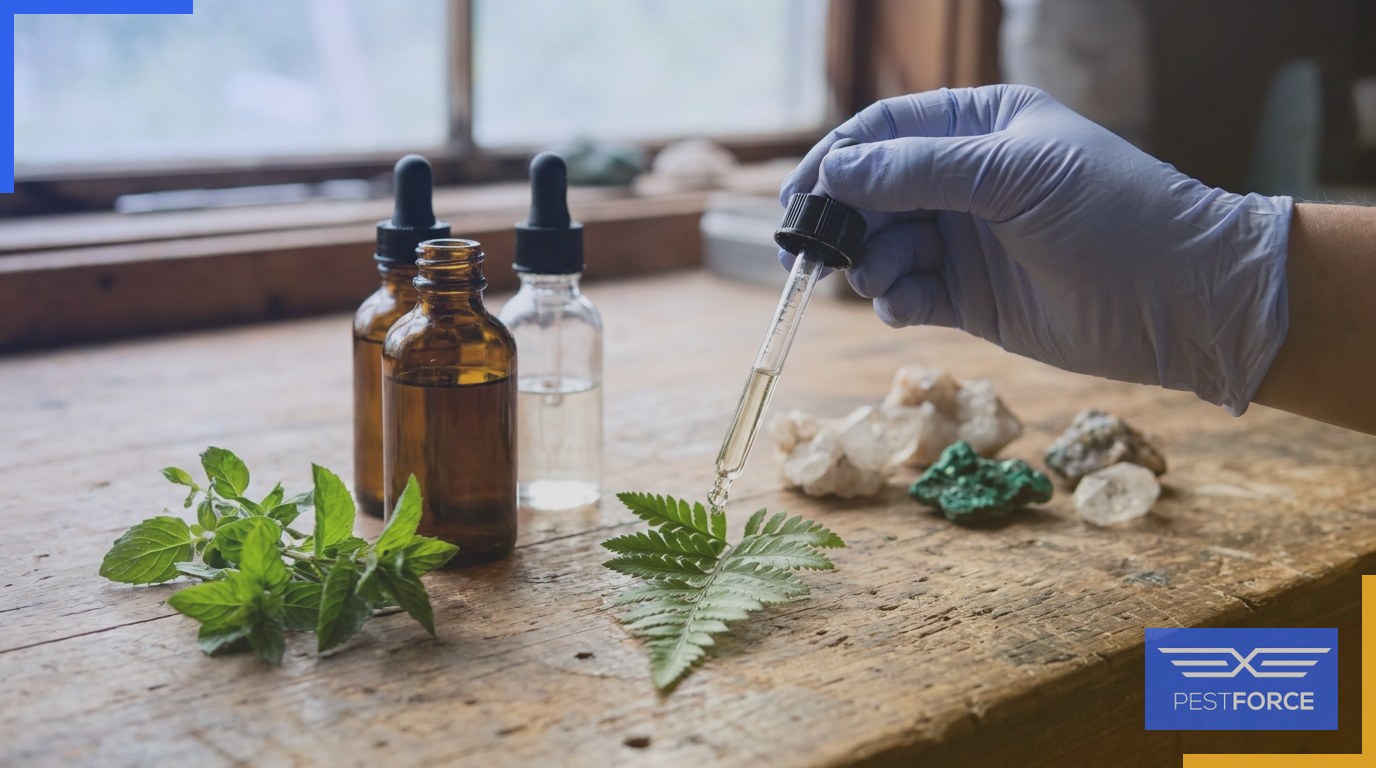
The distinction sits in the source of the active ingredient, not in the hazard level. Botanical actives come from plant tissue, while mineral and microbial actives come from deposits or fermentation. Most naturally sourced products break down faster in sunlight and soil than synthetics, which shortens their residual control and demands more frequent reapplication. Georgia homeowners comparing botanical and organic pest treatments should match each product to the target pest, because the effective spectrum varies widely between products.
One widespread misconception deserves a direct correction: the words “natural” and “organic” do not mean “safe” or “non-toxic.” Botanical pest control products are not equivalent to certified organic or non-toxic products. Pyrethrin proves the point. This flower extract is acutely toxic to bees, aquatic invertebrates, and cats, and its natural origin does not reduce those risks relative to some synthetic alternatives. That bee toxicity is the central concern in pollinator safety with natural pesticides. Chrysanthemum extract sounds gentle. A honeybee would disagree.
The five main categories of organic and botanical methods are:
- Neem oil: pressed from neem tree seeds; the active compound azadirachtin disrupts insect feeding, growth, and reproduction.
- Pyrethrin: extracted from chrysanthemum flowers; a fast-acting nerve toxin with quick knockdown and short residual.
- Essential oils: clove, peppermint, and rosemary oils that kill soft-bodied insects on contact and repel others by scent.
- Diatomaceous earth: fossilized diatom silica that abrades insect cuticles until the pests dehydrate.
- Boric acid: a mined mineral that acts as a stomach poison against ants and cockroaches.
Spinosad, derived from the soil bacterium Saccharopolyspora spinosa, is sometimes grouped with the botanicals. Organic-approved spinosad controls thrips, caterpillars, and fire ants in Georgia landscapes.
Within Integrated Pest Management (IPM), botanical products occupy one tool tier, not the whole toolbox. IPM stacks its tiers in order: prevention through exclusion and sanitation over chemicals comes first, mechanical and cultural controls come second, and targeted chemical application, botanical or synthetic, comes last. IPM’s threshold-based decision-making means treatment starts only when pest counts cross an action threshold, never on a calendar schedule. Households that want to stay below any threshold without sprays can rely on proven non-toxic pest control approaches such as sealing entry points, trapping, and habitat modification.
Federal law treats these products the same as synthetics at the registration counter. According to Texas A&M AgriLife Extension’s Landscape IPM guidance (2010), products containing ingredients derived from plants are considered pesticides and must be registered by the EPA under FIFRA. Registration makes the product label a binding legal document, so applicators must follow the stated rates, sites, and target pests exactly.
How does neem oil work as a pest control product, and what pests does it control?
Neem oil works as an insect growth regulator, not a contact killer. Neem oil contains azadirachtin, which disrupts insect molting and reproduction rather than killing on contact, and neem oil controls aphids, whiteflies, spider mites, fungus gnats, and other soft-bodied insects.
An insect contacts or ingests azadirachtin on treated foliage, and azadirachtin blocks the release of the morphogenic peptide hormones governing molting and reproduction, according to ScienceDirect Topics (Elsevier). Nymphs and larvae fail to molt, and survivors develop slowly. ScienceDirect Topics (Elsevier) reports azadirachtin is most effective on eggs and small larvae, so application timing matters. Reproduction stalls, and the pest population collapses over one to two reproductive cycles.
That delayed action trips people up. Visible pest numbers barely drop in the first days after spraying, so many users incorrectly conclude that neem oil failed and abandon treatment right when neem oil is actually working on the reproductive cycle. Anyone evaluating neem oil as a pest control product should judge results after two weeks, not the morning after.
Homeowners weighing neem oil pest control uses will find the target list leans toward the soft-bodied insects most common in Georgia landscapes, gardens, and greenhouses.
The tradeoff is staying power. Sunlight and rain break neem oil down fast, and the U.S. Environmental Protection Agency (2012) confirms rapid environmental degradation while finding adverse effects from dietary exposure highly unlikely. Users should reapply neem oil every 7 to 14 days while pest pressure stays active.
Neem oil also carries fungicidal activity against powdery mildew and certain plant diseases, making neem oil a dual-purpose product for gardeners managing pest and disease pressure at the same time.
What is pyrethrin and how does it differ from synthetic permethrin?
Pyrethrin is a botanical insecticide derived from the flowers of Chrysanthemum cinerariifolium, the pyrethrum daisy. Pyrethrin differs from permethrin in persistence: pyrethrin breaks down within hours to days in sunlight, whereas permethrin is a synthetic compound engineered for persistence.

The U.S. Environmental Protection Agency (2020) classifies pyrethrins as botanical insecticides derived from chrysanthemum flowers and classifies pyrethroids such as permethrin as synthetic derivatives of pyrethrins. Pyrethrin disrupts sodium channels in insect nervous systems and causes rapid knockdown of the target pest. Research published in the Oriental Journal of Chemistry reports field half-lives of only a few hours to a couple of days for pyrethrins, and the rapid degradation sharply reduces groundwater contamination and residue on harvested produce. Pyrethrin is acutely toxic to bees, aquatic invertebrates, and cats, so a natural origin does not guarantee a harmless product. The Connecticut Agricultural Experiment Station reports that both pyrethrin and permethrin are highly toxic to bees.
The pyrethrin vs. permethrin breakdown and the pyrethrin origin and permethrin potency guide cover how the natural extract and the synthetic analog compare in strength, persistence, and risk profile.
Commercial pyrethrin products commonly add piperonyl butoxide (PBO), a synergist that inhibits the insect enzymes that would otherwise break down the pyrethrin and thereby increases the potency of the formulation. According to the Oriental Journal of Chemistry, PBO is itself a synthetic compound, so a pyrethrin-PBO formulation is not purely botanical.
Pollinator safety is a cross-cutting concern for any botanical product used near flowering plants. Applicators should never spray pyrethrin on blooming plants or during pollinator foraging hours.
How does diatomaceous earth kill insects, and when should you use it at home?
Diatomaceous earth kills insects mechanically: microscopic silica shards abrade the waxy cuticle, and the insect dehydrates until death. Use food-grade diatomaceous earth indoors in dry, enclosed areas such as wall voids, because Georgia’s high humidity limits outdoor and crawl-space applications.
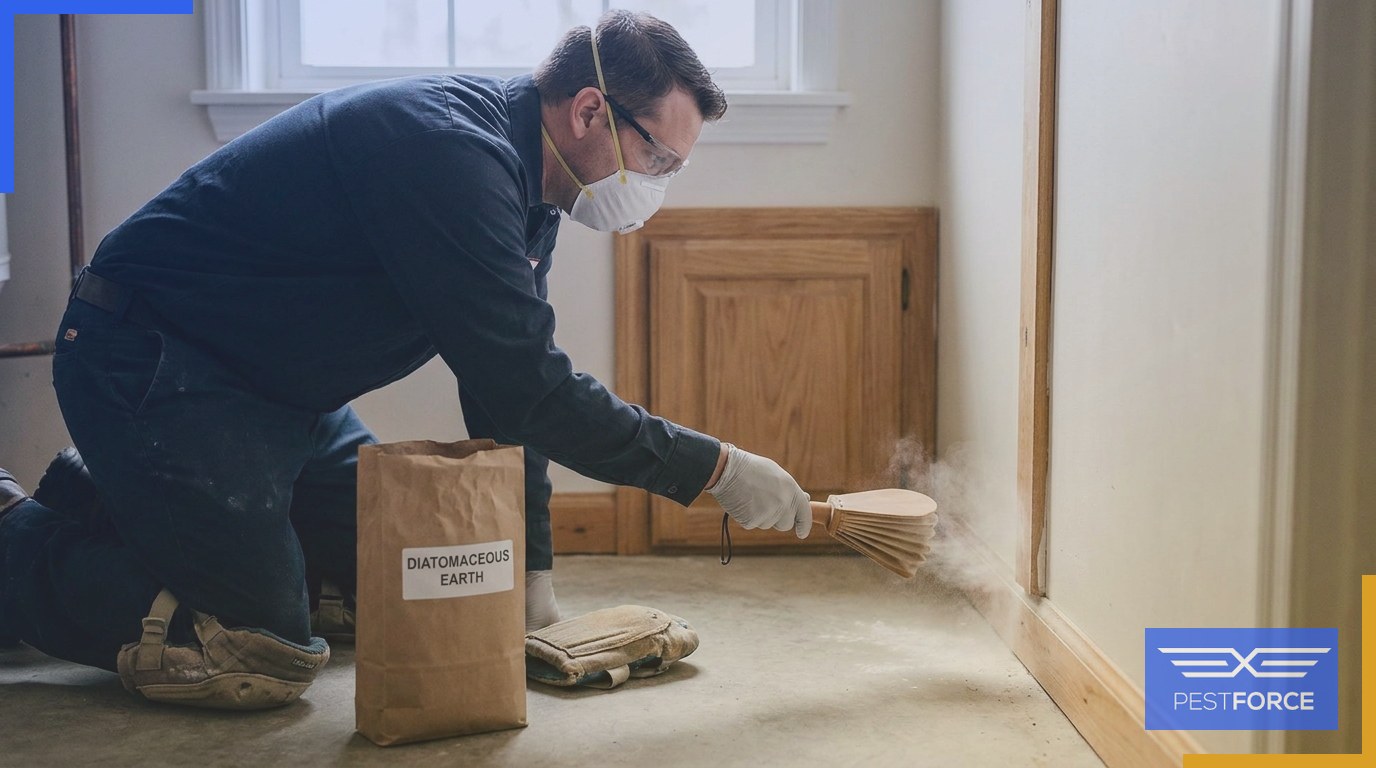
Because diatomaceous earth works through physical abrasion rather than chemical toxicity, no insect population can develop resistance to silica dust. The particles also absorb the cuticle’s protective waxes, so a treated insect loses moisture the insect cannot replace. Death follows from desiccation, not poisoning.
Diatomaceous earth targets the crawling pests that cross treated zones: cockroaches, ants, silverfish, and bed bugs. Any of these insects picks up lethal particles by walking across a thin treated layer.
Only food-grade diatomaceous earth belongs in a home. Filter-grade (pool-grade) DE undergoes heat treatment, contains high levels of crystalline silica, and harms lungs if inhaled. The diatomaceous earth for home pest control guide and the food-grade DE pest control guide cover safe product selection and handling for residential treatments.
Apply diatomaceous earth where Georgia homes stay dry:
1. Choose a labeled food-grade product, never pool-grade material. 2. Puff a thin, barely visible layer into dry enclosed spots: behind appliances, inside wall voids, and under sinks. A dusting you can barely see outperforms a pile you can. 3. Leave the powder dry and undisturbed, and reapply after any cleaning or moisture exposure.
Diatomaceous earth loses efficacy when exposed to high humidity, a significant limitation in Georgia’s climate. Ambient humidity in Georgia regularly runs above 70% RH in summer, and damp particles clump instead of abrading cuticles. High humidity therefore rules out outdoor treatments and humid crawl spaces, confining diatomaceous earth to dry indoor applications.
Do essential oils actually repel insects, and which ones have scientific support?
Essential oils repel specific insects, and research supports four options above the rest: peppermint oil deters ants and spiders, clove oil deters ants, eucalyptus oil discourages mosquitoes with limited effect, and cedarwood oil repels moths.

Essential oils function as repellents rather than lethal agents, requiring frequent re-application to maintain effect. The essential oils that repel insects work by masking scent trails and overwhelming insect sensory receptors, which pushes pests away from treated surfaces without killing them or shrinking the colony behind the problem.
Volatility limits every oil on that list. Most essential oils evaporate within hours to one or two days, so the deterrent barrier fades fast and each treated area needs fresh product to hold any effect. Georgia heat speeds that evaporation along.
Essential oil treatment fits a prevention routine, not an infestation response. A homeowner facing an active ant trail or roach pressure needs a control method that eliminates the population; oils can supplement that work but cannot stand in for it.
How does boric acid work for pest control and how do you use it safely indoors?
Boric acid is classified as a stomach poison and desiccant, not a contact killer. Cockroaches, ants, and silverfish must ingest boric acid; a thin dust in cracks and wall voids kills colonies slowly and poses low acute toxicity to people and pets at label-use rates.
The slow kill is the whole point. Workers walk through the dust, groom the powder off their bodies, swallow the dose, and carry the poison back to the nest before dying, which produces a cascading colony-reduction effect across insects that never touched the treatment. Impatient applicators destroy that mechanism: reapplying boric acid too soon or combining boric acid with repellent products disrupts the transfer mechanism and eliminates the primary advantage boric acid holds over contact killers, because repellents scatter workers off treated routes before the workers pick up a lethal dose.
Apply boric acid correctly with three steps:
1. Apply a thin, barely visible film. Insects cross a light dusting without hesitation; thick piles get avoided because insects simply walk around heavy deposits. 2. Place the dust where insects travel. Treat cracks and crevices, behind and under appliances, along cabinet backs, and inside wall voids. 3. Leave the treatment undisturbed. Boric acid needs days to work, and re-dusting the area interrupts the colony transfer.
Anyone applying boric acid pest control at home should keep the powder off food preparation surfaces and away from children and pets. Boric acid carries low acute toxicity to humans at label-use concentrations, but that margin depends on placement: dust belongs in voids and cracks, never on countertops, open shelving, or pet feeding areas.
Sources
- U.S. Environmental Protection Agency, “Docket Number EPA-HQ-OPP-2008-0331, Pyrethroids and Pyrethrins (Revised Ecological Risk Mitigation Response)” (2020)
- ScienceDirect Topics (Elsevier), “Azadirachtin – an overview”
- U.S. Environmental Protection Agency, “BIOPESTICIDES REGISTRATION ACTION DOCUMENT – Cold Pressed Neem Oil” (2012)
- Oriental Journal of Chemistry, “Evaluation of Plant-Derived Natural Pesticides and their Environmental Impact” (2026)
- U.S. Environmental Protection Agency, “US EPA Pesticide Product Label – EVERGREEN (pyrethrin-based product)” (2017)
- Connecticut Agricultural Experiment Station, “Protecting Pollinators from Pesticides – Dr. Kimberly Stoner” (2018)