

House mice, Norway rats, roof rats, and squirrels are Georgia’s four primary rodent pests, each with distinct biology, movement patterns, and seasonal behavior. Misidentifying which rodent has infested a Georgia home leads directly to failed control, because a trap or exclusion method sized for a roof rat will not stop a house mouse ranging 10 feet along the same baseboard. Knowing how each rodent species lives, moves, and reproduces lets homeowners match the control method to the animal.
What biological traits do all Georgia rodents share that make them hard to control?
All Georgia rodents share continuously growing incisors that drive compulsive gnawing, high reproductive rates, reliance on smell and touch over vision, and wariness of environmental change. These shared traits let rodents damage structures, multiply quickly, and evade control tools placed without biology in mind.
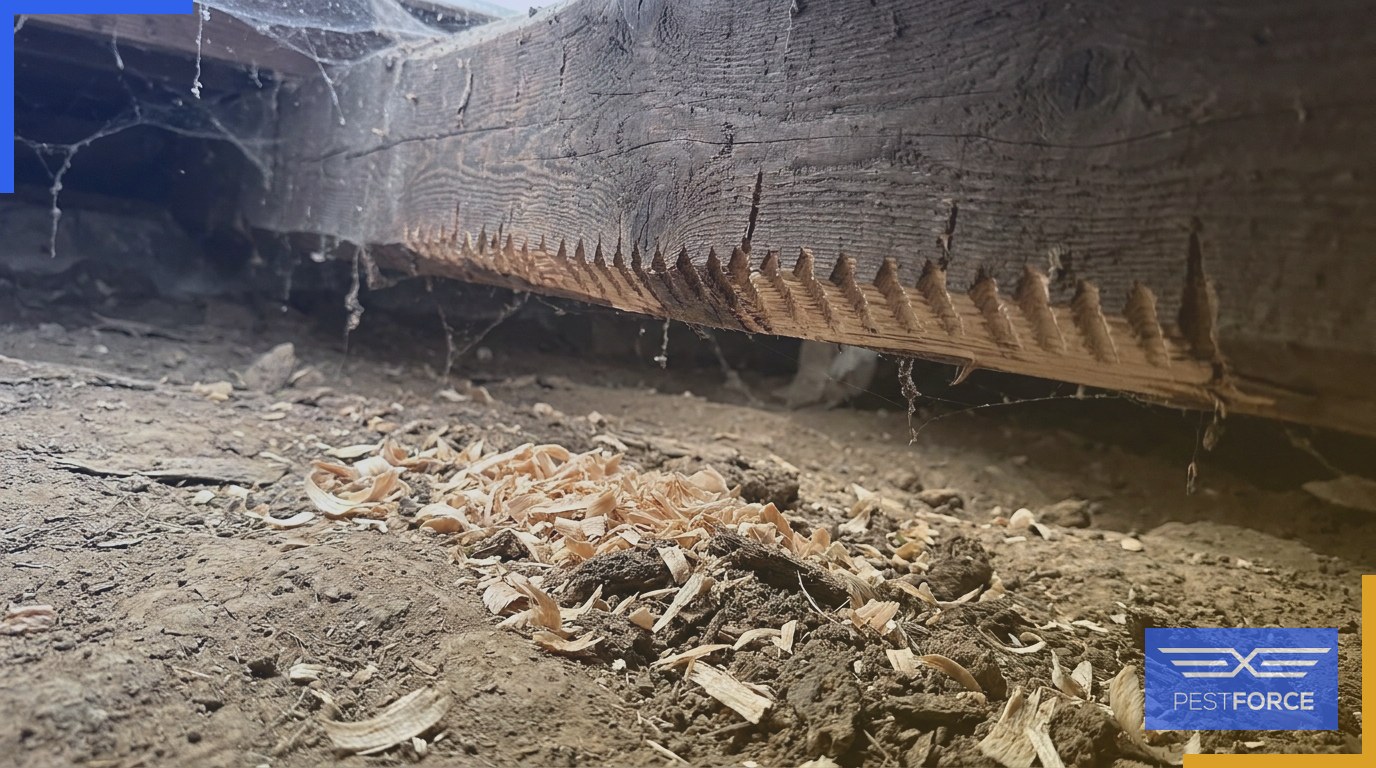
Continuously growing incisors define the order Rodentia, whose name comes from the Latin *rodere*, “to gnaw.” House mice, Norway rats, roof rats, and Eastern gray squirrels all carry the same equipment. Rodent incisors cause compulsive gnawing on any material, including wires, pipes, and joists, because the teeth grow continuously and must be worn down. That single trait produces most rodent structural damage and the fire risk behind stripped wire insulation. Squirrels put the same teeth to work gnawing entry holes along rooflines and keeping those holes open. Homeowners asking what drives rodent chewing instincts are really asking about tooth growth, because the gnawing never stops on its own.
High reproductive rates amplify every other trait. All four species produce multiple litters per year, and the young reach breeding age in weeks or months, a generational turnover faster than most other household pests manage. A single overlooked pair can seed a full infestation within a season, which is why delayed treatment costs more than prompt treatment. Every week of delay also widens exposure to the disease transmission risks from rodents.
Neophobia, the fear of new objects, varies by species and dictates trap strategy. Pest Control Technology reports that all three commensal species exhibit neophobic behavior, with rats showing stronger neophobic tendencies than mice. Pest Control Technology also notes that rats approach new bait stations cautiously, treating changes in the environment as potential threats until the rats re-habituate. Mice lean the other way and investigate novelty, so mouse traps often catch on the first night. A strongly neophobic rat will avoid a newly placed trap for an extended stretch, so pre-baiting, which means placing baited but unset traps out for several days before setting them, dramatically improves catch rates, especially with Norway rats.
Activity timing splits Georgia rodents into two shifts. House mice, Norway rats, and roof rats work at night, so droppings, gnaw marks, and wall sounds surface overnight, and inspections pay off after dark or at first light. Eastern gray squirrels work the daylight shift, which puts attic noise in the morning and late afternoon. Squirrels also cache food inside structures, tucking nuts into attics and wall voids, so a quiet attic at noon does not clear a property.
Senses explain where rodents travel. Spokane County Public Health reports that rats have poor eyesight beyond three or four feet and rely on hearing and other senses. Rodents navigate mainly by smell and touch, keeping whiskers and body hair against vertical surfaces in a wall-following habit called thigmotaxis. Thigmotaxis is where understanding Georgia rodent behavior turns into placement strategy: traps set perpendicular to a wall with the trigger end against the wall intercept normal travel, and exclusion work targets the runways rodents already use.
How do house mice behave and move inside Georgia homes?
House mice live and move within a small area close to the nest, often no farther than a single room or wall void. House mice enter Georgia homes through narrow foundation gaps, nest in wall voids and insulation, and investigate new objects in their path with cautious curiosity.
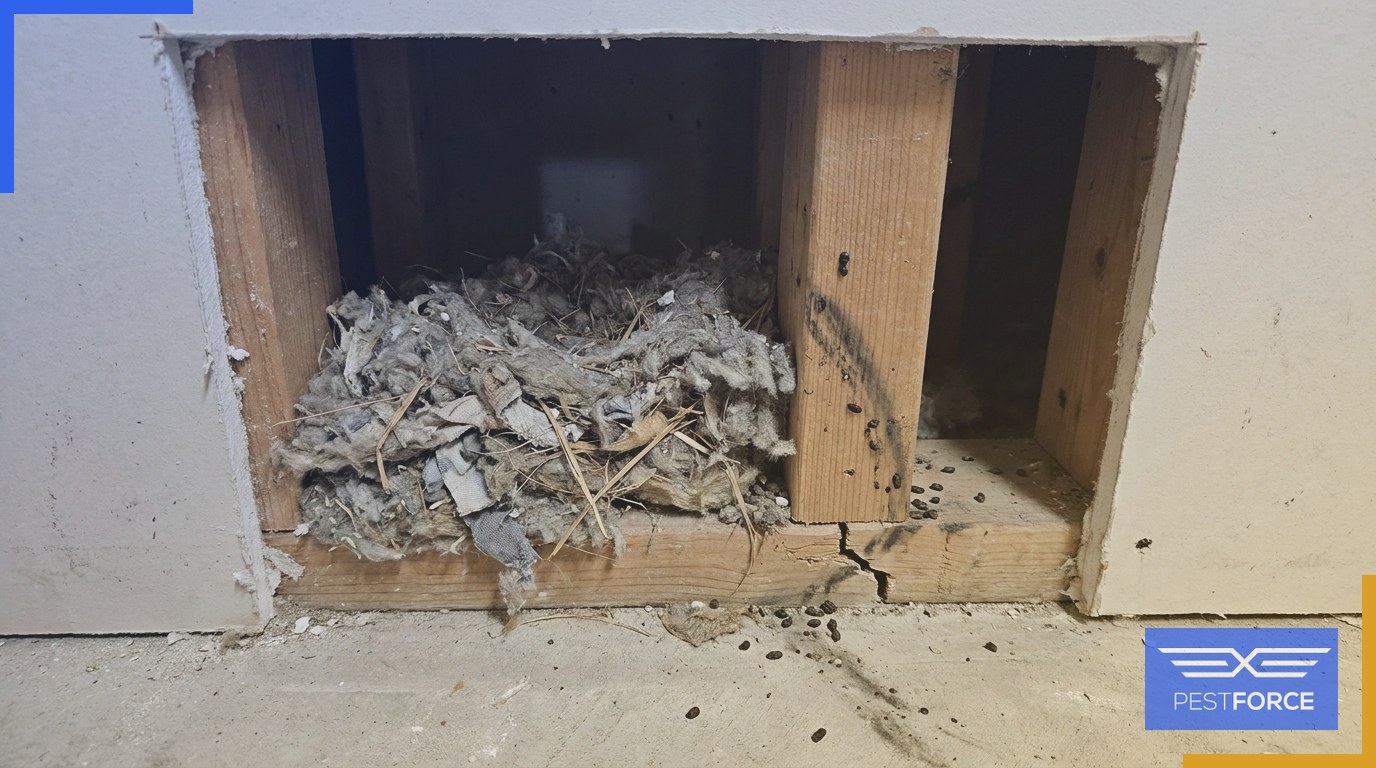
Body size drives the behavior. The house mouse is small, slender, and light, and that build shapes how house mice use a structure.
1. Entry through tiny gaps. A house mouse needs only a narrow opening to get indoors. Gaps in Georgia pier-and-beam and slab foundations that look too small to matter will admit a mouse, because the house mouse body compresses through tight spaces.
2. A tight home range. Once inside, a house mouse stays near the nest. The house mouse holds a home range extending only a short distance from the nest, far smaller than the range of either rat species, so an entire colony can operate within a single room or wall void. The rodent home range and territory differences between mice and rats explain why mouse activity so often centers on one kitchen or one wall line.
3. Hidden nesting sites. House mice nest in wall voids, insulation, and the spaces behind appliances. These spots stay undisturbed and sit close to food, which lets a colony grow without crossing open floor.
4. Cautious but curious exploration. House mice investigate new territory carefully, yet mice approach new objects faster than rats do. Pest Control Technology (PCT) describes mice as “curious” toward new traps and bait stations, attracted to new objects within their territories. That curiosity makes trap placement easier, and the same curiosity lets house mice spread quickly through a structure.
Deer mice and white-footed mice live in rural North Georgia and carry Hantavirus. Their biology and risk profile differ from those of the house mouse, though their entry behavior and indoor range look much the same.
What is the difference between Norway rat and roof rat behavior in Georgia?
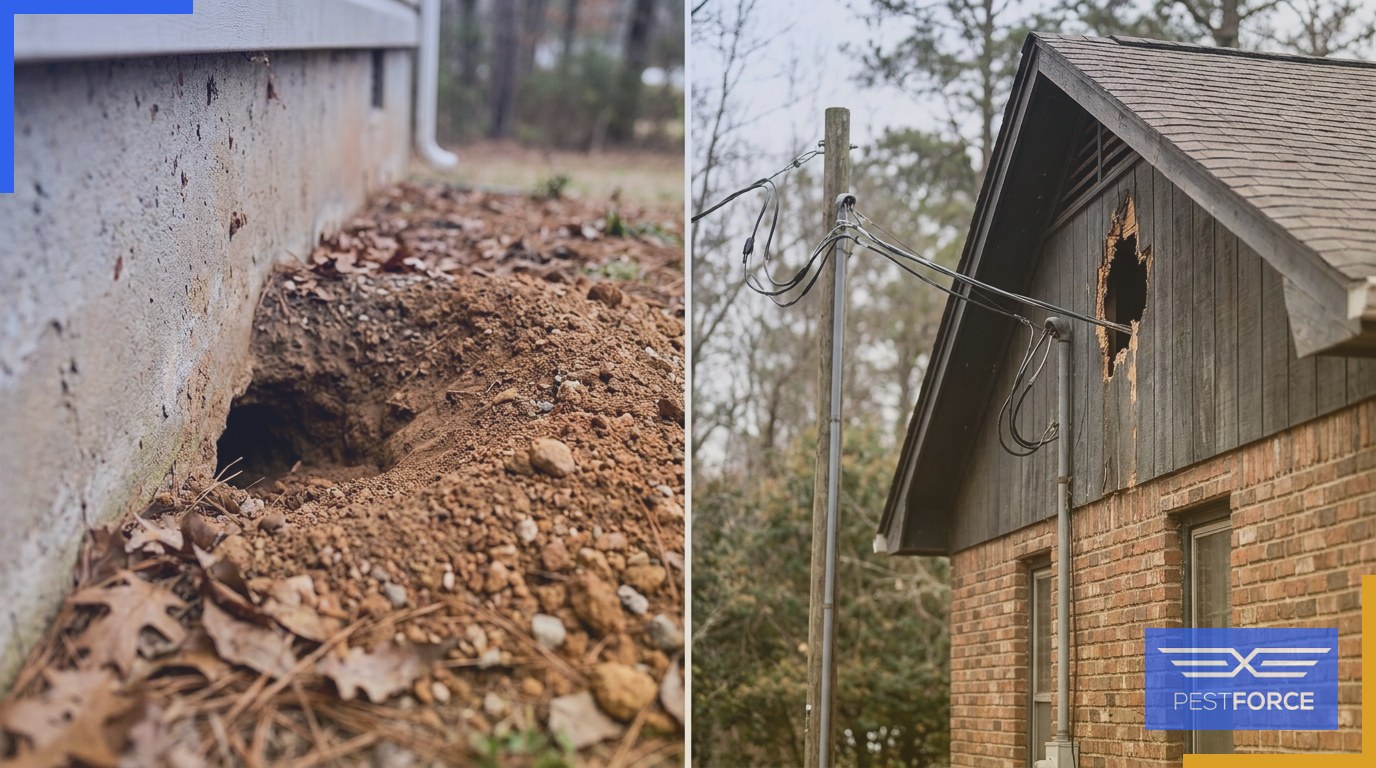
Norway rats burrow at ground level along foundations and enter buildings at grade, while roof rats climb and enter overhead through rooflines, gable vents, and utility lines. Roof rats dominate coastal Georgia; Norway rats are more common in agricultural and suburban areas statewide.
| Behavior | Norway rat | Roof rat |
|---|---|---|
| Body build | Heavier, thick-bodied | Smaller, sleeker; tail longer than body |
| Nesting | Soil burrows along foundations, under slabs, in crawl spaces | Attics, upper wall voids, trees |
| Entry points | Weep holes, gaps at grade, pipe penetrations | Rooflines, gable vents, overhanging branches, utility lines |
| Diet | Omnivore favoring protein: meat, fish, pet food, garbage | Prefers fruit, nuts, seeds, tree-borne foods |
| Georgia range | Agricultural and suburban areas statewide | Coastal Georgia (Savannah, Brunswick, Golden Isles) and Atlanta tree-canopy corridors |
The Norway rat has a burrowing behavior that positions nests at or below ground level along foundations and crawl spaces. The roof rat uses overhead entry routes such as eaves, tree branches, and utility lines rather than ground burrows. Entry points rarely lie.
Both species range far wider than a house mouse. According to the University of California Agriculture and Natural Resources (UC IPM), Norway rats forage 100 to 500 feet from their nests each night, and roof rats routinely travel 300 feet or more for food. The rat in a crawl space may nest next door or commute from a dumpster down the street.
Correct identification is a prerequisite for effective control, not an academic exercise. Roof rats require traps and exclusion at ceiling height and overhead entry points; Norway rats require ground-level burrow treatment. The wrong method wastes time and materials while the infestation grows. The identifying Georgia rat species by signs covers the droppings and rub marks that separate the two species, and the extermination strategies by rodent behavior maps those differences to control methods.
How fast do rodents reproduce, and why does Georgia’s climate make it worse?
House mice reach sexual maturity at five to seven weeks, carry a gestation of 19 to 21 days, and produce 5 to 10 litters per year. Georgia’s mild winters remove the northern breeding pause, so house mice and rats reproduce during all 12 months.
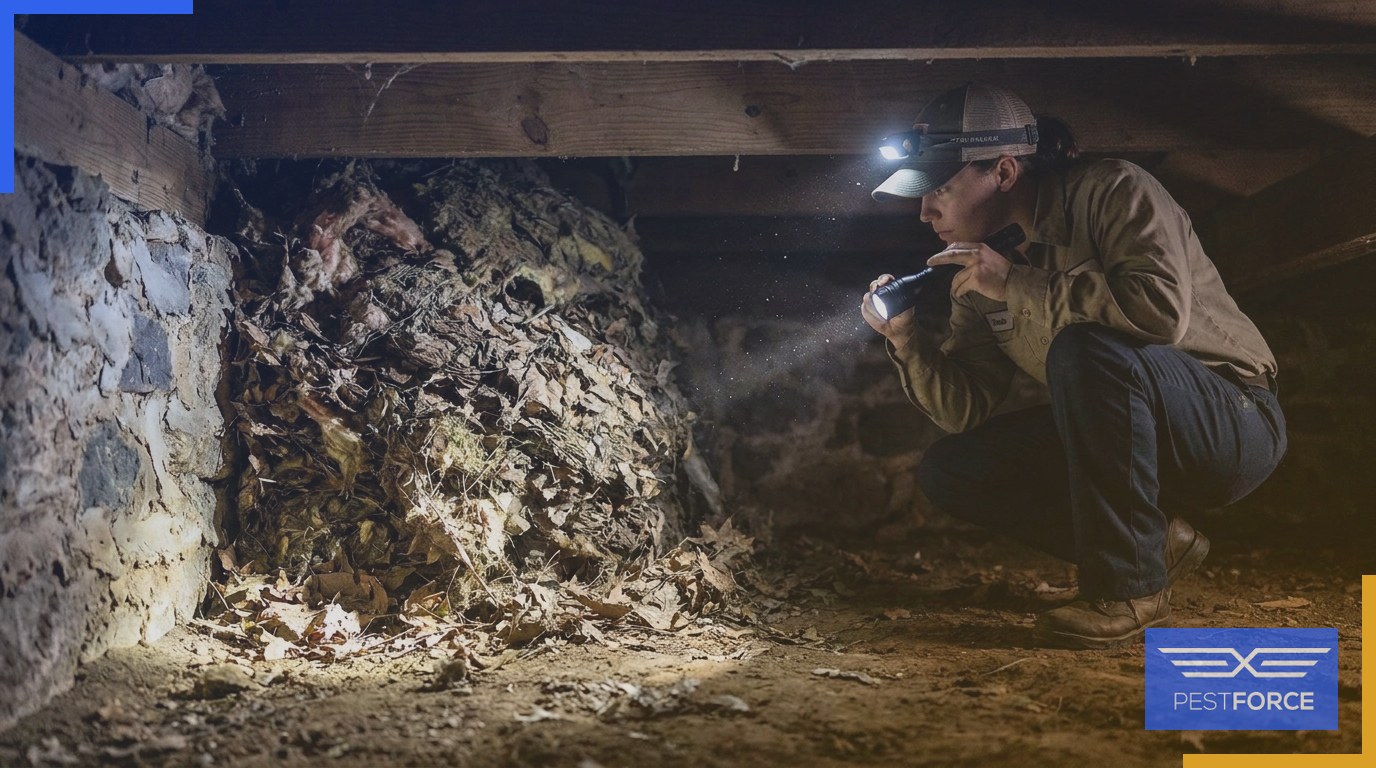
One breeding pair becomes an established colony within 12 months, and the compounding follows a fixed sequence:
1. Maturity at five to seven weeks. According to Animal Diversity Web at the University of Michigan Museum of Zoology, house mouse pups are weaned at three weeks and reach sexual maturity at five to seven weeks. 2. Gestation of 19 to 21 days. A female house mouse delivers each litter in under three weeks. 3. Postpartum estrus within 12 to 18 hours. Animal Diversity Web reports that female house mice enter estrus 12 to 18 hours after giving birth, so a new pregnancy begins almost immediately. 4. Five to ten litters per year. The house mouse has a reproductive potential of up to 10 litters per year under Georgia’s mild climate, with as many as 14 reported when conditions stay suitable.
The mouse reproduction rates explained tracks this same compounding timeline across a full Georgia year.
Norway rats and roof rats mature more slowly than house mice and produce fewer litters annually, but a rat colony still doubles within a single season. University of California Agriculture and Natural Resources (UC IPM) reports that roof rats average three to five litters per year with up to eight pups per litter.
Colder states force a winter breeding pause that shrinks rodent populations before spring. Georgia’s climate skips that reset, which means the mouse or rat colony a homeowner discovers in October reflects 12 continuous months of reproduction, not one busy summer.
When and why do rodents enter Georgia homes seasonally?
Mice and rats enter Georgia homes each fall as nights cool, beginning in September and October in North Georgia and October and November on the coastal plain. Eastern gray squirrels enter attics twice yearly, in January-February and June-July, when females seek enclosed birthing space.
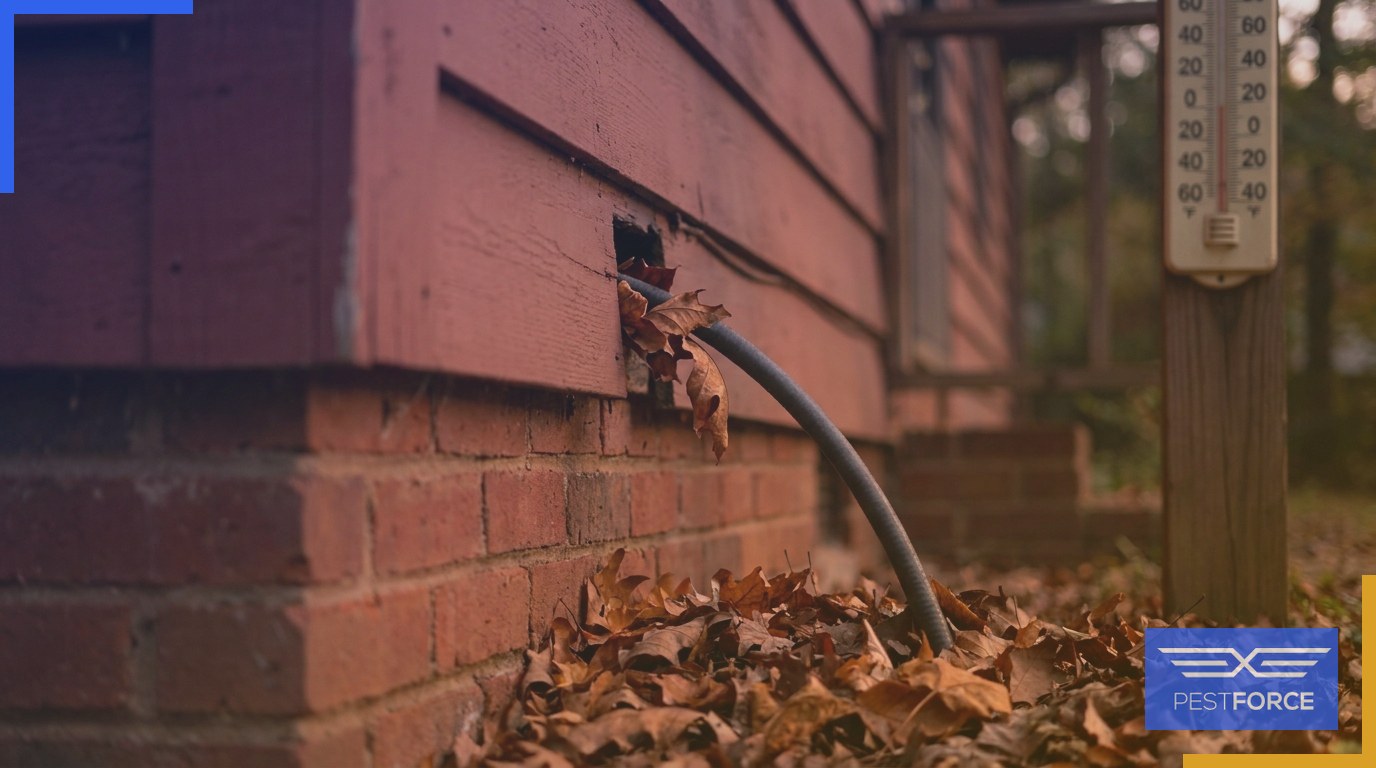
The fall temperature drop in Georgia causes mice and rats to seek indoor harborage. As nights cool, both species follow warm air escaping through gaps around doors, utility lines, and foundation vents. That leaking heat explains why mice migrate indoors in fall; a drafty wall gap reads like a vacancy sign to a mouse. The Georgia habitat preferences of rodents add to the pressure, since Norway rats, roof rats, and house mice all live alongside human structures year-round.
Summer drought acts as a secondary driver of indoor entry. When Georgia’s dry stretches eliminate outdoor water sources, rodents move toward buildings for moisture, not only for relief from cold. Entry also carries a compounding risk: house mice breed throughout the year indoors, while wild mice reproduce mainly from April to September, according to the Animal Diversity Web at the University of Michigan Museum of Zoology.
Squirrels follow a breeding calendar instead of a temperature calendar. The eastern gray squirrel has two distinct breeding seasons in Georgia, January-February and June-July, creating two attic-entry pressure peaks per year. During both windows, pregnant females seek enclosed, predator-free attic space for birthing.
Never exclude squirrels during either breeding peak. Sealing entry points while a litter nests inside traps the young, and a locked-out mother will chew through new repairs to reach them. The correct Georgia exclusion windows run late August through December and March through May.
Fox squirrels and flying squirrels also enter Georgia attics, but both species are far less common than the eastern gray. Flying squirrels are nocturnal, so scratching heard overhead at night points to flying squirrels while daytime noise points to grays.