
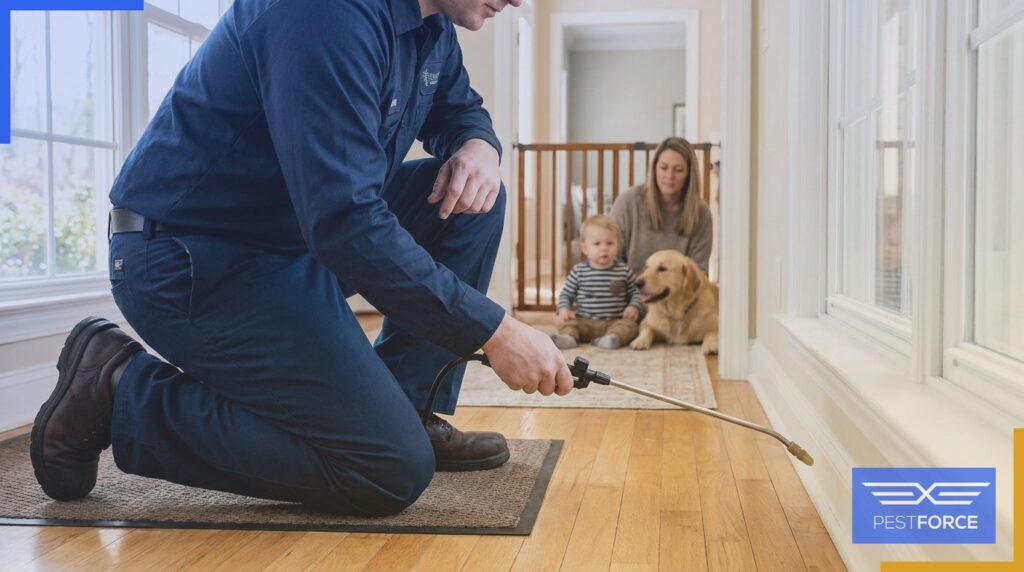
Pet-safe and child-safe pest control eliminates infestations with low-toxicity products, careful application methods, and enforced re-entry times that protect a household’s most vulnerable members. Conventional pest control creates real exposure risk when a homeowner chooses the wrong product or lets children and pets back onto treated surfaces too soon. Georgia homeowners who understand pesticide signal words, product categories, and application methods can get effective pest control without gambling on household safety.
Why are children and pets more vulnerable to pest control chemicals than adults?
Children and pets face higher exposure risk than adults due to floor-level contact, hand-to-mouth behavior, and faster respiratory rates relative to body weight. The EPA confirms that children take in more pesticides relative to body weight than adults, and that their developing organ systems are more vulnerable and less able to detoxify toxic chemicals.

The exposure starts at ankle height. According to the U.S. Environmental Protection Agency, children spend more time on the floor, where pesticide residues transfer to skin and absorb through it, and they frequently place their hands and objects in their mouths, producing what regulators call non-dietary ingestion. Crawling infants live in that residue zone all day. Dogs sniff treated baseboards and turf at nose level and then lick their paws, giving them an ingestion route no adult has.
Body size multiplies the dose. Children breathe faster and carry a higher skin-surface-to-body-weight ratio than adults, so the same room air and the same treated surface deliver more chemical per pound of body mass. The EPA reports that children are less developed immunologically, physiologically, and neurologically, and pesticide law requires the EPA to apply an extra 10-fold safety factor, if necessary, to protect infants and children.
Pets face their own version of the problem, and cats sit at the worst end of that risk. Beyond Pesticides reports that cats absorb more chemicals than dogs because of their grooming habits, and that as specialist carnivores cats lack certain liver enzymes that detoxify chemicals. CriticalCareDVM.com identifies one missing enzyme by name: cats lack glucuronyl transferase, the liver enzyme that detoxifies pyrethrins and pyrethroids. VCA Animal Hospitals warns that even a small exposure to products containing pyrethroids can produce life-threatening signs in cats.
Pest control that is genuinely safe for children and pets starts with needing less chemical in the first place. Families searching for child-safe and pet-safe pest control will find that reducing the need for pesticides is the most effective first step. Integrated pest management reduces chemical exposure by prioritizing physical exclusion, habitat modification, and biological controls before any pesticide application. Parents and pet owners evaluating pesticide exposure for kids start with the floor-level zones where residues and children actually meet, and exclusion work like sealing entry points and correcting moisture removes the conditions Georgia pests depend on before product ever touches those surfaces.
Pregnant residents carry an overlapping but distinct risk profile, with fetal exposure routes that differ from child-and-pet exposure pathways. Households expecting a baby can review pest control safety during pregnancy for the pregnancy-specific precautions and low-toxicity options that apply before the baby arrives.
How do I read a pesticide label to know if a product is safe for my household?
The EPA signal word on the front panel answers most of the question. Caution indicates the lowest acute toxicity class, and families should treat Caution as the minimum threshold for products used indoors. Warning and Danger mark higher toxicity tiers.
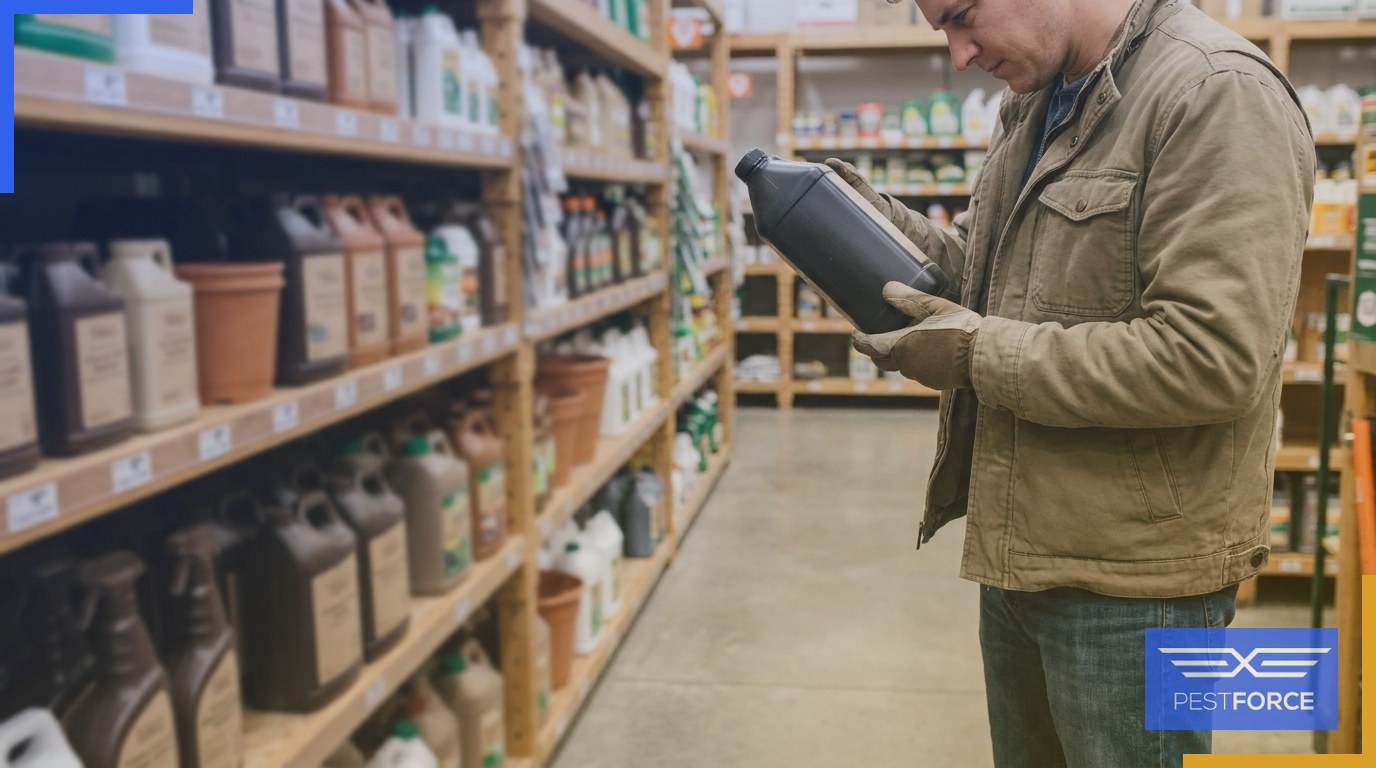
1. Check the signal word first. The Electronic Code of Federal Regulations requires CAUTION on Toxicity Category III products, WARNING on Category II, and DANGER on Category I. Category I products with oral, inhalation, or dermal hazards must also display the word Poison in red with a skull and crossbones. The National Pesticide Information Center explains that the most sensitive route of entry determines the signal word, so high skin toxicity alone earns a DANGER label even when oral toxicity is low. The University of Nevada, Reno Extension adds that signal words reflect acute, single-dose toxicity only and say nothing about long-term or repeated exposure.
2. Read the active ingredient statement. The active ingredient kills the pest; inert ingredients carry the active ingredient into the pest. Federal regulations do not require manufacturers to fully disclose inert ingredients, and some inerts are solvents that pose their own risks. The word inert does not mean harmless.
3. Ignore the “Keep Out of Reach of Children” statement as a safety signal. The U.S. Environmental Protection Agency reports that the statement appears on almost all end-use pesticide products, so the phrase cannot distinguish one product from another. The signal word and the active ingredient are the meaningful indicators.
4. Pull the Safety Data Sheet. Manufacturers publish a Safety Data Sheet for each product on the company website, and the product page typically links to the sheet. Section 8 covers exposure controls and protective equipment, and Section 11 covers toxicological information. Product categories that already meet the Caution threshold appear in the least-toxic pest control products guide for households that want the screening done for them. That guide also highlights low-risk pest solutions for households looking to reduce cumulative chemical exposure without sacrificing effectiveness.
Which pest control products and methods are safest for homes with children and pets?
The safest options for homes with children and pets are tamper-resistant bait stations, crack-and-crevice applications, insect growth regulators such as methoprene and pyriproxyfen, food-grade diatomaceous earth, and boric acid placed inside sealed voids. Enclosed placement reduces exposure more than any broadcast spray.
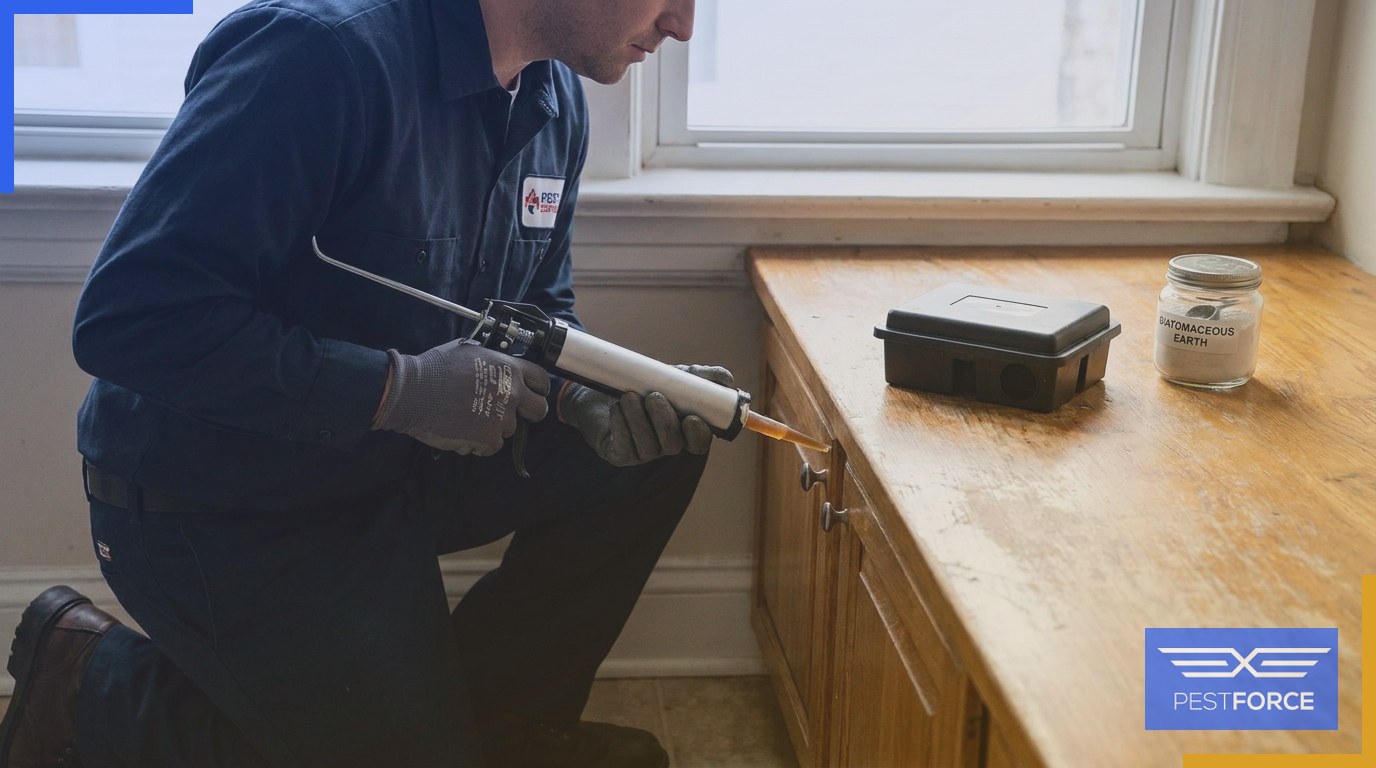
A bait station carrying the same active ingredient as a broadcast spray poses far less exposure risk, because the chemical stays locked where only insects reach it. Crack-and-crevice applications work the same way: the gel or dust sits inside gaps insects use. Careful placement protects children and pets as much as low product toxicity does.
How long should children and pets stay out of the house after pest control treatment?
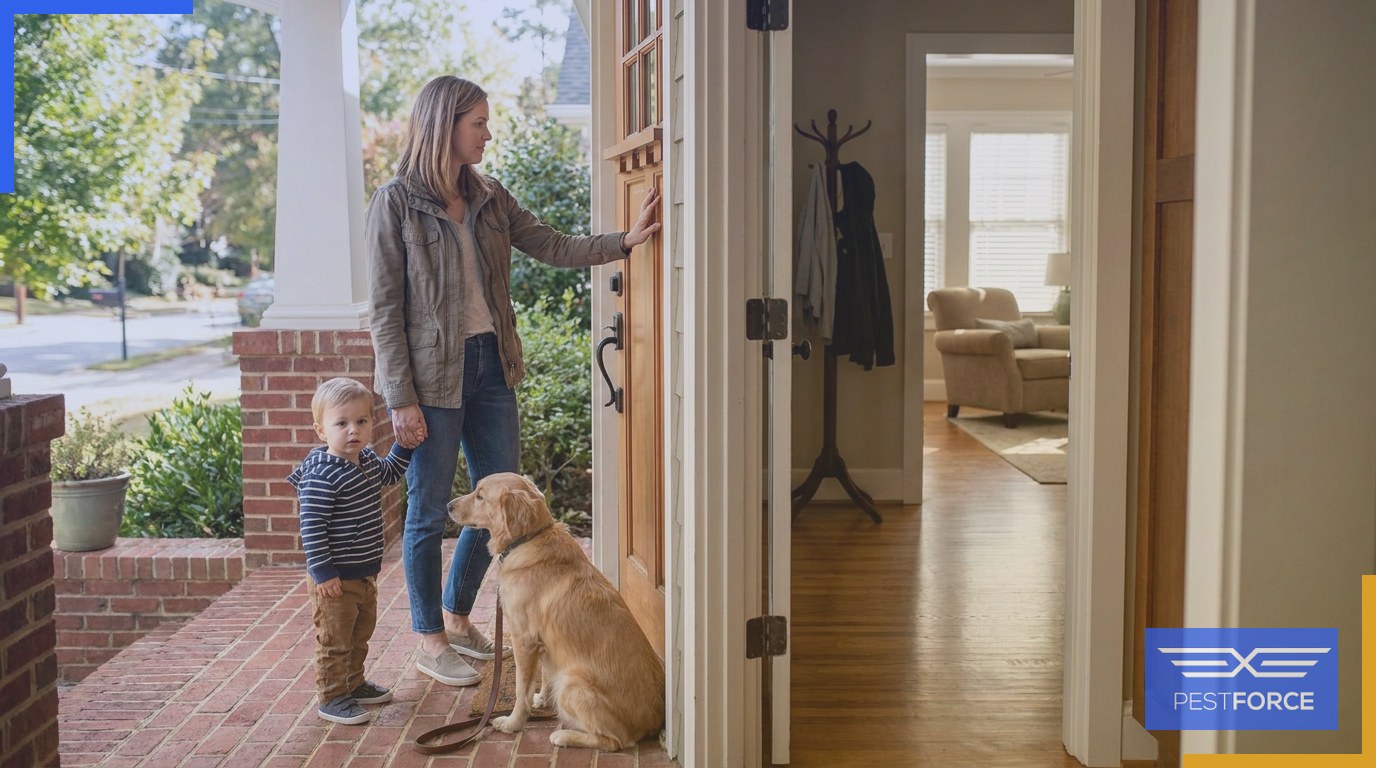
Children and pets should stay out of the house until the product label’s re-entry interval has fully passed, plus a safety buffer, because the printed interval is a legal minimum for healthy adults rather than a figure calibrated for infants, toddlers, or pets. According to the U.S. Environmental Protection Agency, re-entry intervals were designed for adults and children at least 12 years old, so households with infants, toddlers, or pets should double or triple the labeled time.
Re-entry interval varies by formulation type: baits and dusts applied in voids typically allow faster re-entry than broadcast sprays applied to open surfaces. Formulation type drives re-entry timing more than active ingredient does, so broadcast sprays on open surfaces demand the longest wait while bait stations and crack-and-crevice dusts allow the fastest return. The formulation a technician applies largely determines when pets can safely return indoors. Choosing a flea treatment that protects pets means selecting the formulation with the shortest re-entry window and the lowest residue on surfaces pets contact.
Crawling infants contact treated floors directly, and dogs and cats groom residues off their fur, so households with crawlers and groomers should apply 2 to 3 times the labeled interval as a precautionary standard. Households should also open windows and run fans during and after the labeled interval to accelerate off-gassing of any spray carrier solvents.
Fish and aquatic pets are disproportionately sensitive to pyrethrins and pyrethroids. Cover aquarium tanks and turn off air pumps before any spray treatment in the same room, even if the label describes the product as safe for dogs and cats. Temporary tank relocation forms part of keeping animals safe during extermination. These same principles apply to backyard mosquito control safe for children, where spray drift and puddle residues can reach both kids and pets.
How do I choose a pest control company that uses child-safe and pet-safe products?
Professional pest control services should be evaluated by asking for the SDS (Safety Data Sheet) for every product used, confirming written re-entry times, and verifying the technician’s knowledge of pet- and child-specific protocols. Any company advertising pet-safe and child-safe pest control should answer four questions before treatment day.
1. Request the SDS for every product. A reputable provider emails Safety Data Sheets without hesitation. Each sheet lists the active ingredient, signal word, and first-aid measures, so you can check every product against your household before anyone treats it.
2. Ask whether the technician will broadcast spray or use targeted application. Gel baits, crack-and-crevice treatments, and void dusting place material inside pest harborage where children and pets cannot reach it. Broadcast spraying coats the baseboards and floors that toddlers and dogs contact all day, so targeted application is materially safer.
3. Confirm written re-entry times for children and pets separately. “Wait until dry” is not a re-entry time. Ask for specific hours for each, because a crawling infant and a floor-licking Labrador face different exposure than an adult walking through in shoes.
4. Ask about IPM training and non-chemical options. A company trained in Integrated Pest Management exhausts exclusion, sanitation, and trapping before any chemical application. If the first answer to every problem is a sprayer, keep shopping.
Georgia’s warm, humid climate keeps pest pressure active year-round, so treatment frequency runs higher than in northern states. Households with children or pets do better on a quarterly IPM-based service plan than on reactive single treatments, because a planned program reduces cumulative chemical exposure over time. Expecting parents asking is pest control safe during pregnancy can apply these same four questions to any provider they interview.
Sources
- Beyond Pesticides, “Children and Lawn Chemicals” (2005)
- U.S. Environmental Protection Agency, “Resources about Pesticides and Integrated Pest Management in Child Care Settings”
- U.S. Environmental Protection Agency, “Assessing Human Health Risk from Pesticides” (2026)
- Beyond Pesticides, “Pets and Pesticides: Keeping our Companions Safe”
- CriticalCareDVM.com, “Pyrethrin and Pyrethroid Toxicity in Cats: What Pet Owners and Veterinary Teams Need to Know” (2018)
- VCA Animal Hospitals, “Pyrethrin/Pyrethroid Poisoning in Cats” (2026)
- University of Nevada, Reno Extension, “Pesticide Risk Assessment: Understanding Signal Words on Pesticide Labels”
- U.S. Environmental Protection Agency, “Label Review Training: Module 2: Parts of the Label, Page 2” (2026)
- U.S. Environmental Protection Agency, “Report of the Food Quality Protection Act (FQPA) Tolerance Reassessment – EPA Archive”